
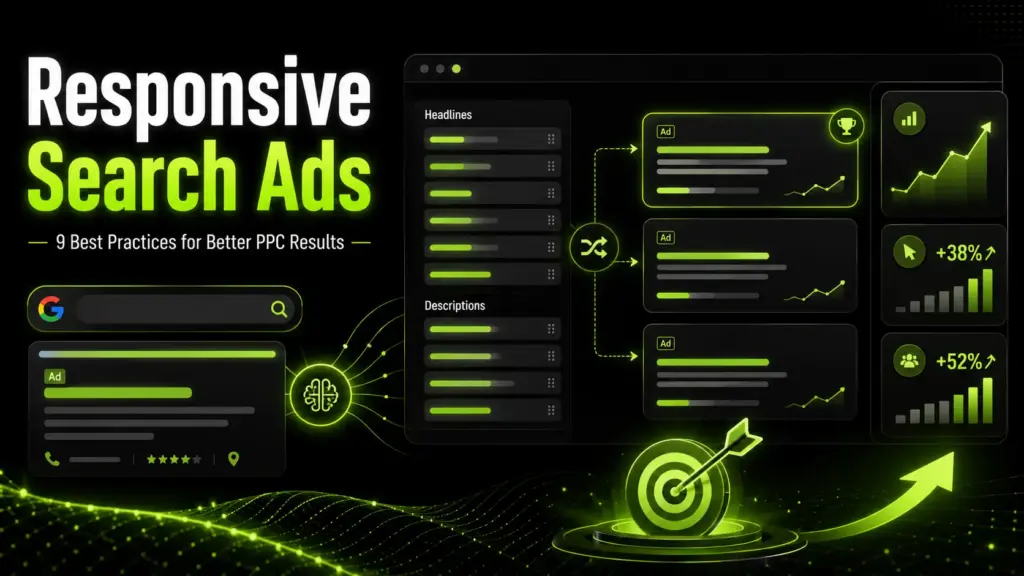
Responsive search ads are a Google Ads format where advertisers provide multiple headlines and descriptions, and Google automatically tests different combinations to show the most relevant ad to each searcher. Instead of writing one fixed search ad, you give Google several messaging options. The platform then mixes those assets based on the search query, user intent, device, and performance signals.
When used correctly, responsive search ads can improve relevance, test ad copy faster, increase coverage across different search queries, and support stronger PPC performance. The key is not simply filling every headline field. The real value comes from writing useful, varied, and intent-focused ad assets.
What Are Responsive Search Ads?
How Responsive Search Ads Work in Google Ads
Google responsive search ads allow advertisers to enter multiple headlines and descriptions inside a single search ad. Google can then combine those assets in different ways depending on what the user searches, what device they use, and which combinations are expected to be most relevant.
For example, one headline may focus on pricing, another may focus on service quality, and another may focus on a free consultation. A description may explain the offer, while another may highlight trust, speed, or experience. Google uses these assets to create different versions of the ad without requiring the advertiser to manually build every variation.
This makes RSAs useful for campaigns where search intent changes across keywords. Someone searching for “Google Ads agency pricing” may need a cost-focused message. Someone searching for “best Google Ads management service” may respond better to proof, experience, or results. Responsive ads help cover those variations inside one ad format.
Why RSA Google Ads Replaced Expanded Text Ads
RSA Google Ads became the main search ad format because it offers more flexibility than older fixed text ads. Expanded text ads used fixed headlines and descriptions. That gave advertisers more control over exact wording, but less room for automated testing.
Responsive ads changed the workflow. Instead of creating many separate ads to test different angles, advertisers can enter multiple assets in one ad. Google then tests combinations over time. This supports faster learning, broader message matching, and more adaptable ad delivery.
That does not mean automation does all the work. Poor headlines still produce poor combinations. Repetitive descriptions still limit testing. RSAs perform best when the advertiser gives Google strong, distinct, and strategically written assets.
How Responsive Search Ads Improve Campaign Performance
Better Message Matching for Different Search Queries
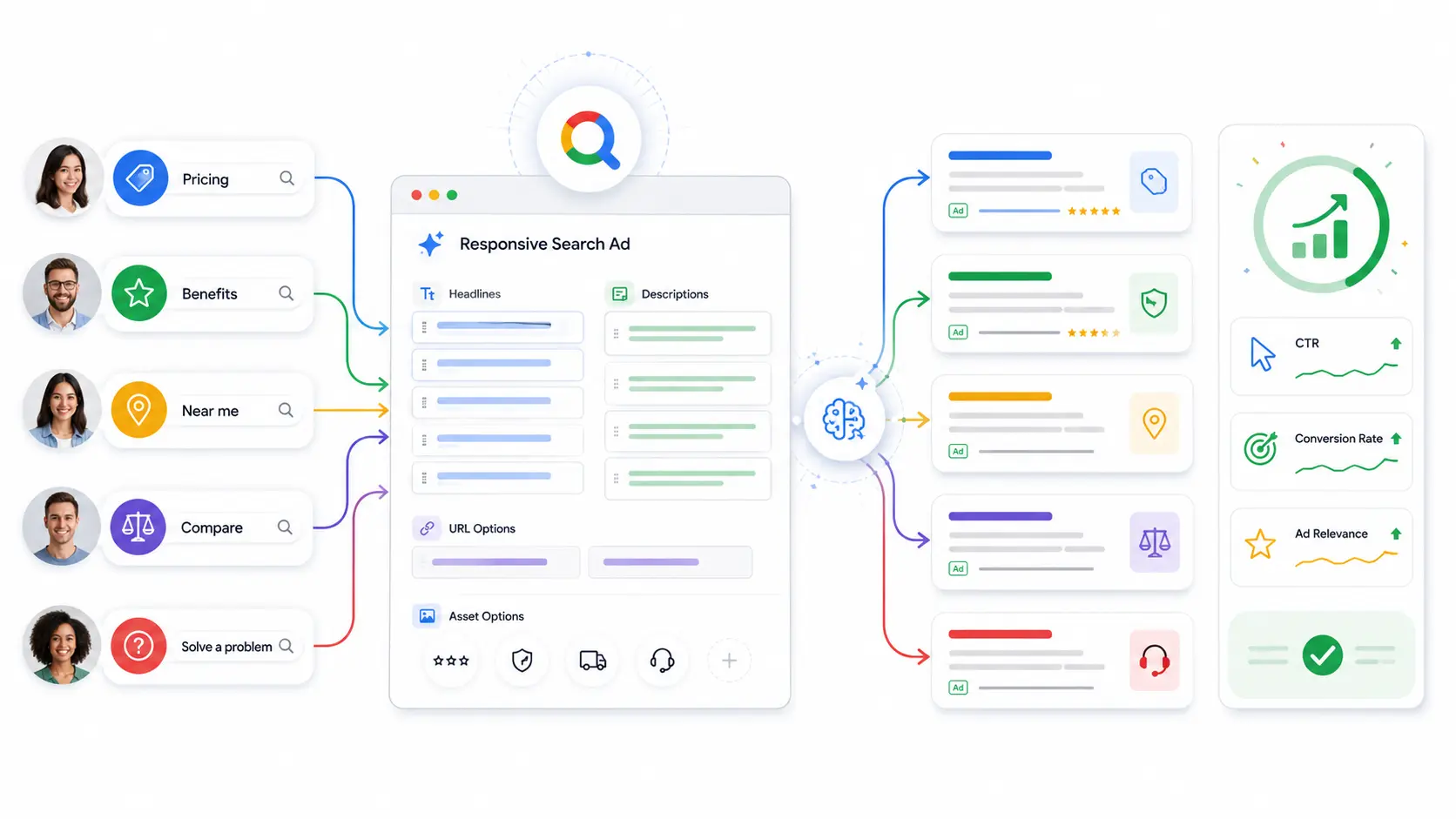
People rarely search with the same intent, even when they are interested in the same service. One user may search for pricing. Another may search for benefits. Another may search for a local provider, a comparison, or a solution to a specific problem.
Responsive search ads help by adapting the message to different searches. A campaign for PPC management could include headlines such as:
- Google Ads Management Services
- Improve Your PPC Results
- Get More Qualified Leads
- Book a Free PPC Consultation
- Trusted Google Ads Support
Each headline speaks to a different angle. When paired with relevant descriptions, Google has more ways to match the ad to the user’s intent. This can help improve ad relevance and support better engagement.
Stronger ad relevance can also support better click-through performance. If you want to improve clicks after users see your ads, this guide on Google Ads CTR explains how click-through rate connects with ad copy, intent, and campaign quality.
More Testing Without Creating Many Separate Ads
Before responsive ads became the standard, advertisers often had to create multiple ad variations manually. That process worked, but it took more time and made testing harder to manage at scale.
With RSAs, testing happens inside the ad. You can add different headlines and descriptions, then review asset performance after the campaign collects enough data. This helps you identify which messages are stronger, which ones are weak, and which angles deserve more attention.
The advantage is speed. You can test benefits, offers, calls to action, brand positioning, and keyword-led headlines without building a separate ad for each idea. The challenge is discipline. If every headline says almost the same thing, the system has very little meaningful variety to test.
9 Responsive Search Ads Best Practices
1. Write Unique Headlines for Each Search Intent
One of the most important responsive search ads best practices is writing headlines that represent different search intents. Do not use every headline slot to repeat the same phrase with slight wording changes.
A strong RSA should include several angles, such as:
- Main service or product
- Main customer benefit
- Trust factor
- Offer or value
- Location, if relevant
- Problem solved
- Call to action
For example, a campaign for a PPC agency could include “Google Ads Management,” “Get More Qualified Leads,” “Improve PPC ROI,” “Book a Free Consultation,” and “Trusted PPC Support.” Each headline has a different purpose.
The goal is to give Google enough useful variation to match different user needs. When headlines are too similar, the ad becomes repetitive and the testing value drops.
2. Include the Main Keyword Naturally
Responsive search ads should include the main keyword in some headlines and descriptions, but not every asset needs to repeat it. Keyword relevance matters, but keyword stuffing can make the ad look robotic.
A good RSA may include the keyword in one or two headlines, then use the remaining assets to communicate benefits, trust, offers, or next steps. For example:
- Responsive Search Ads Guide
- Improve Your PPC Results
- Build Better Google Ads
- Test Stronger Ad Copy
- Get More Relevant Clicks
This gives the ad a balance of keyword relevance and human appeal. The keyword helps connect the ad to the search query, while the supporting assets explain why the user should click.
3. Add Clear Benefits, Not Just Features
Features describe what you offer. Benefits explain why the user should care. In search ads, benefits often create stronger motivation because users are comparing options quickly.
A feature-based headline may say “Google Ads Management.” A benefit-based headline may say “Get More Qualified Leads.” Both can be useful, but the benefit usually feels more connected to the outcome the user wants. A strong RSA uses both. The feature gives clarity, while the benefit gives the user a reason to act.
This is especially important for small businesses. They often need ad copy that quickly explains value, not just service names. If you are building campaigns for a smaller budget, this guide on Google Ads for small business gives helpful context for writing practical, outcome-driven ads.
4. Use Strong Calls to Action
A call to action tells the searcher what to do next. Without a clear CTA, even a relevant ad can feel incomplete.
Good RSA calls to action include:
- Get a Free Quote
- Book a Consultation
- Start Your Campaign
- Compare Your Options
- Improve Your PPC Results
- Request a Strategy Review
- Talk to a Google Ads Specialist
The best CTA depends on the offer and buying stage. A user searching for “PPC agency near me” may be ready to book a consultation. A user searching for “how to improve Google Ads performance” may prefer a guide, audit, or strategy review.
Use CTAs that match the landing page. If the ad says “Get a Free Quote,” the landing page should make that quote easy to request.
5. Avoid Repeating the Same Headline Meaning
A common mistake is writing many headlines that look different but mean the same thing. For example:
- Best Google Ads Agency
- Top Google Ads Agency
- Leading Google Ads Agency
- Expert Google Ads Agency
These headlines are not truly different. They repeat the same claim without adding new value. Google can test them, but the test is weak because the message does not change much.
Better variation would be:
- Google Ads Management
- Get More Qualified Leads
- Reduce Wasted Ad Spend
- Book a Free PPC Review
- Campaigns Built for ROI
This gives Google more distinct ideas to test. It also gives users more reasons to consider the offer.
6. Match Ad Copy with the Landing Page
The ad and landing page should feel like one continuous experience. If the ad promises a free consultation, the landing page should mention the same offer. If the ad focuses on lead generation, the landing page headline should support that promise.
A strong match includes:
- Similar headline message
- Same offer or CTA
- Relevant proof or trust signals
- Clear next step
- Content that matches the user’s search intent
This matters because a click is only the first step. If users land on a page that feels disconnected from the ad, they may leave quickly. That can hurt conversion performance and waste budget.
For deeper landing page improvements, this Google Ads landing page guide explains how page relevance, copy, and conversion structure work together.
7. Use Pinning Carefully
Pinning lets you control where certain headlines or descriptions appear. For example, you can pin a brand name to headline position one or a legal disclaimer to a specific description position.
Pinning is useful when a message must appear in a certain place. Good use cases include:
- Legal disclaimers
- Brand name requirements
- Important offer details
- Required compliance text
- Location-specific messaging
However, too much pinning can limit Google’s ability to test combinations. If every important asset is pinned, the RSA behaves more like a fixed ad. That can reduce the flexibility that makes responsive ads useful.
A practical approach is to pin only what is necessary. Let Google test the rest.
8. Review Asset Performance Regularly
Responsive ads are not “set and forget.” After enough data has collected, review asset performance. Google may label assets as low, good, or best based on how they perform within combinations.
Weak assets should not always be removed immediately. Sometimes they need more data. But if a headline or description continues to perform poorly, replace it with a stronger variation.
Look for patterns. Are benefit-led headlines outperforming generic service headlines? Are offer-based CTAs getting stronger engagement? Are location-based messages helping local campaigns? These insights can improve not only one ad, but your wider PPC strategy.
Regular review helps you keep the campaign fresh and aligned with search behavior.
9. Test Responsive Search Ads with Remarketing Campaigns
Responsive ads can also support remarketing strategies. Previous website visitors may already know your brand, so they may respond to different messages than first-time searchers.
For remarketing audiences, you can test headlines that focus on:
- Returning to compare options
- Booking a consultation
- Claiming a limited offer
- Reviewing services again
- Taking the next step
For example, someone who visited a PPC services page but did not convert may respond better to “Still Comparing PPC Options?” or “Book Your Free Strategy Review.” These messages feel more relevant to users who already showed interest.
If you want to reconnect with previous visitors, this guide on a Google Ads remarketing campaign explains how remarketing can support stronger PPC follow-up.
Responsive Search Ads vs Other Google Ads Formats
Responsive Search Ads
Advertisers provide headlines and descriptions. Google combines those assets for search campaigns based on query, intent, device, and performance signals.
Dynamic Search Ads
Google uses website content to help generate ad headlines for relevant searches, which can support wider keyword coverage for larger websites.
Responsive Search Ads vs Dynamic Search Ads
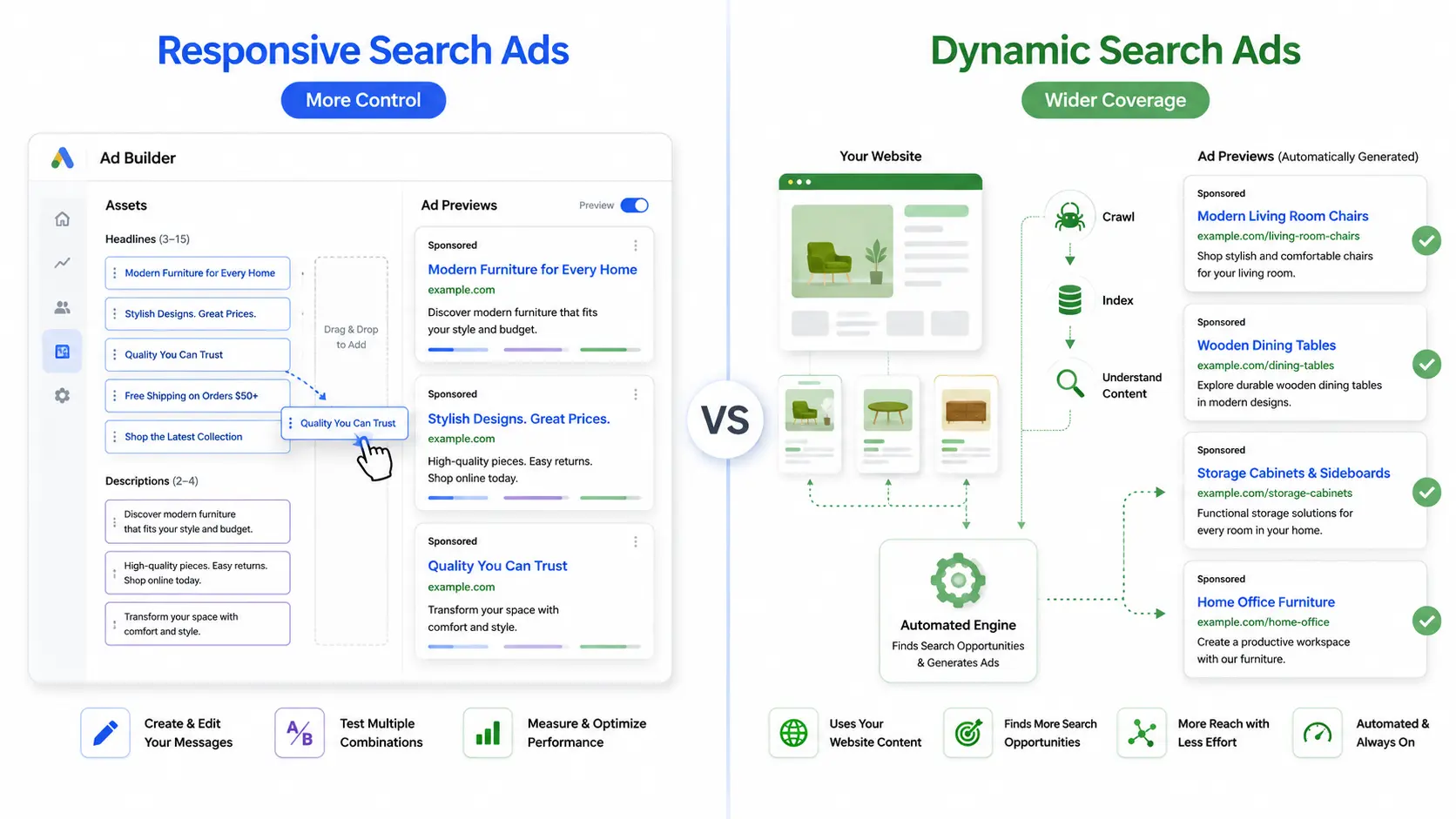
Responsive search ads use advertiser-provided headlines and descriptions. You write the assets, and Google combines them based on the search and performance signals. This gives you more control over the messaging.
Dynamic search ads work differently. They use website content to help generate ad headlines for relevant searches. This can help cover keyword opportunities you may not have added manually, especially for larger websites with many pages.
The main difference is control. RSAs give you more control over copy. Dynamic search ads can offer wider keyword coverage. Many advertisers use RSAs for core campaigns and dynamic search ads for additional discovery, coverage, or long-tail search opportunities.
Responsive Search Ads vs Performance Max Ads
Responsive search ads appear in Search campaigns. They are designed for text-based ads on Google search results. You choose keywords, write ad assets, and optimize around search intent.
Performance Max campaigns are broader. They can appear across multiple Google channels, depending on the campaign setup and available assets. Performance Max uses automation across placements, while RSAs are focused specifically on search ads.
For advertisers who want tighter control over keyword intent and search ad copy, responsive ads remain important. They allow you to write specific messages for people actively searching for your product or service.
Common RSA Google Ads Mistakes to Avoid
Using Too Many Similar Headlines
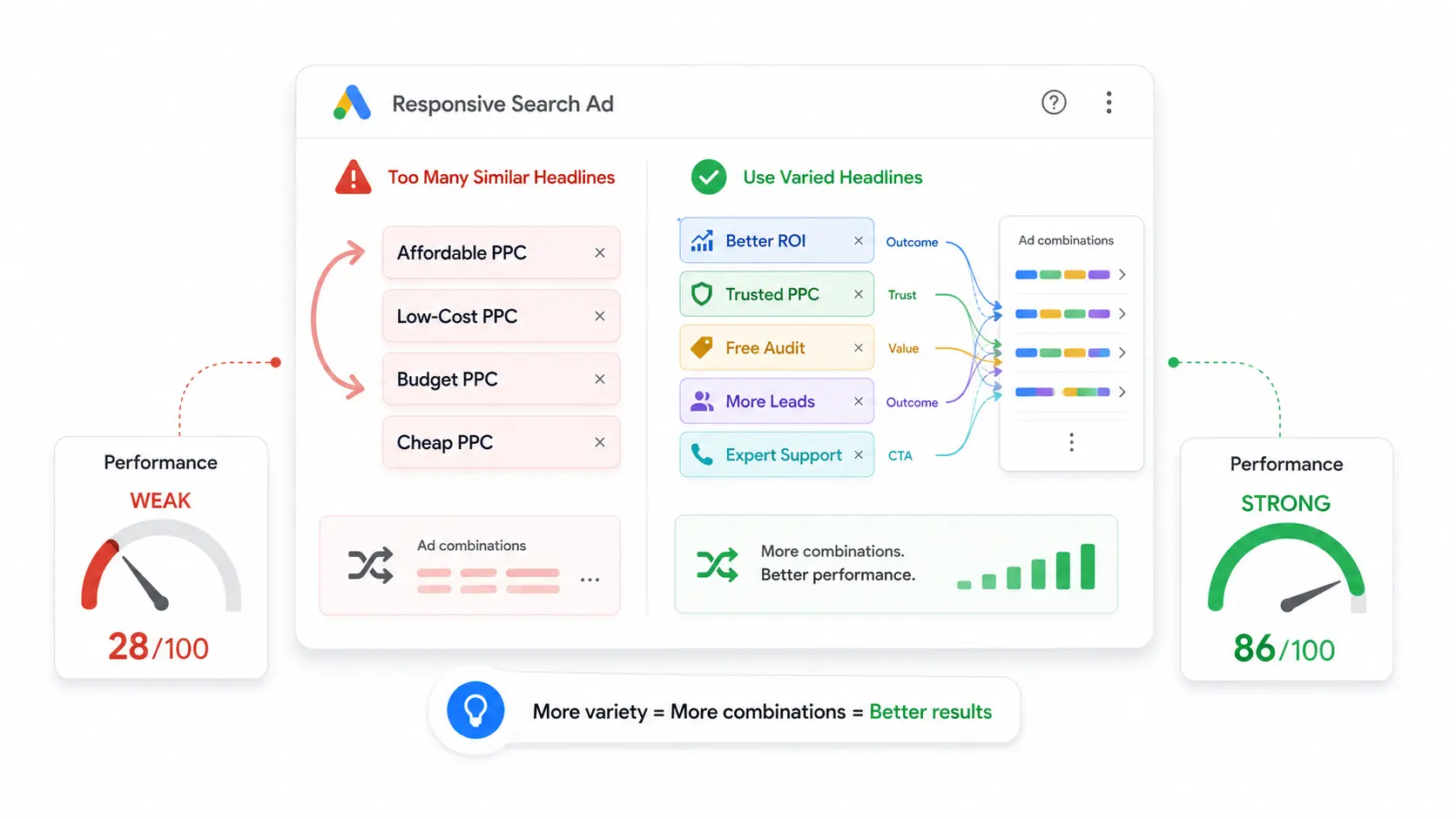
Using too many similar headlines is one of the fastest ways to weaken an RSA. If all headlines repeat the same idea, Google has fewer meaningful combinations to test.
For example, these headlines are too similar:
- Affordable PPC Services
- Low-Cost PPC Services
- Budget PPC Services
- Cheap PPC Services
They all focus on price. A stronger ad would include price, value, trust, outcome, and CTA angles. Variety gives the system more room to match different user motivations.
Ignoring Landing Page Relevance
Strong ad copy is not enough if the landing page does not continue the same message. A searcher who clicks an ad about “Google Ads lead generation” expects a page that explains lead generation, not a generic marketing services page.
The landing page should answer the promise made in the ad. It should also make the next step obvious. If the ad promotes an audit, the page should explain the audit and show how to request it.
Campaign performance depends on both ad copy and landing page quality. When those two parts work together, clicks are more likely to turn into leads or sales.
Writing Generic Descriptions
Descriptions give you room to explain value, trust, offer, or next step. Generic descriptions waste that space.
Poor example: “We offer professional services.” Better example: “Launch targeted Google Ads campaigns designed to attract more qualified leads.”
The better version explains what the user gets and why it matters. It is specific, outcome-focused, and connected to PPC intent. Strong descriptions should support the headlines, not repeat them word for word.
Use descriptions to add clarity. Mention the benefit, process, audience, offer, or CTA.
Not Reviewing Performance Data
RSAs need ongoing review. Even well-written ads can become stale as competitors change, offers shift, and search behavior evolves.
Important performance checks include CTR, conversion rate, cost per conversion, asset strength, and search term relevance. If your ads are getting clicks but not conversions, the issue may be the landing page, offer, keyword targeting, or audience quality.
If you need hands-on campaign support, professional PPC ads management services can help with ad copy testing, landing page alignment, keyword strategy, and ongoing optimization.
How to Measure Responsive Search Ads Performance
Important Metrics to Track
Responsive search ads should be measured with both ad-level and campaign-level data. Do not judge performance based on one metric alone.
Shows whether the ad attracts clicks.
Shows whether clicks turn into results.
Helps you understand traffic cost.
Shows financial efficiency.
Helps evaluate RSA setup quality.
Shows stronger and weaker messages.
Reveals real user intent.
Shows post-click relevance.
Shows visibility opportunities.
CTR helps you understand whether the ad is attracting clicks. Conversion rate shows whether those clicks are turning into results. Cost per conversion tells you whether the campaign is financially efficient.
Asset performance can guide copy improvements, but it should be viewed alongside real business outcomes. A headline may attract clicks, but if those clicks do not convert, the message may be too broad or misaligned with intent.
When to Update Your RSA Assets
You should update RSA Google Ads assets when performance data shows weak results, when search intent changes, or when your offer changes. You may also need updates after competitors shift their messaging or when a campaign has collected enough data to identify low-performing assets.
Useful times to refresh assets include:
- CTR drops over time
- Conversion rate declines
- Cost per conversion rises
- Search terms reveal new intent
- Offers or pricing change
- Seasonal demand changes
- Asset ratings remain weak
- Landing page messaging changes
Avoid making changes too quickly before the campaign has enough data. At the same time, do not ignore obvious issues. If several headlines are repetitive, vague, or disconnected from the landing page, improve them.
Final Thoughts on Responsive Search Ads
Why Strong RSA Copy Still Matters
Automation can test combinations, but it cannot turn weak messaging into a strong strategy. Responsive ads work best when the advertiser provides clear, varied, and relevant assets.
Strong RSA copy should include keywords, benefits, trust signals, offers, and CTAs. It should also match the landing page and reflect the user’s real search intent. When these elements work together, Google has better inputs to test and users receive more relevant messages.
What to Do Next
Start by reviewing your current ads. Look for repeated headlines, generic descriptions, missing benefits, weak CTAs, and landing page mismatches. Then rewrite assets around different user intents.
Responsive search ads are useful because they allow more ad copy variation, better message matching, and stronger testing inside Google Ads. Success depends on strong headlines, clear descriptions, relevant keywords, proper landing pages, and regular optimization. When responsive search ads are built with strategy instead of filler text, they can become one of the most effective tools in a PPC campaign.
Need Help Improving Google Ads Performance?
Get professional PPC support for ad copy testing, keyword strategy, landing page alignment, and ongoing Google Ads optimization.
View PPC Ads Management Services →Frequently Asked Questions
Responsive search ads are a Google Ads search ad format where you provide multiple headlines and descriptions. Google then tests different combinations to show the most relevant version to each user. This helps advertisers match different search queries, improve ad relevance, and test more messaging angles without creating many separate ads manually.
Responsive search ads can improve campaign performance by matching ad copy more closely to user intent. Since Google can test different headline and description combinations, the system can learn which messages work better for different searches. However, performance still depends on strong copy, relevant keywords, landing page quality, and proper campaign optimization.
The best practices for writing responsive search ads include using unique headlines, adding clear benefits, including keywords naturally, avoiding repetition, writing strong calls to action, and matching the ad copy with the landing page. It is also important to review asset performance regularly and replace weak headlines or descriptions with better variations.
You should use enough headlines to give Google different messages to test. The goal is not only to fill all available fields, but to create useful variety. Headlines should cover different benefits, offers, trust signals, keywords, and calls to action. Avoid writing many headlines that repeat the same idea in slightly different words.
Responsive search ads are more flexible than expanded text ads because they allow multiple headlines and descriptions inside one ad. Google can test different combinations and choose more relevant versions for different searches. Expanded text ads were more fixed, while RSAs give advertisers more testing opportunities when the assets are written properly.