
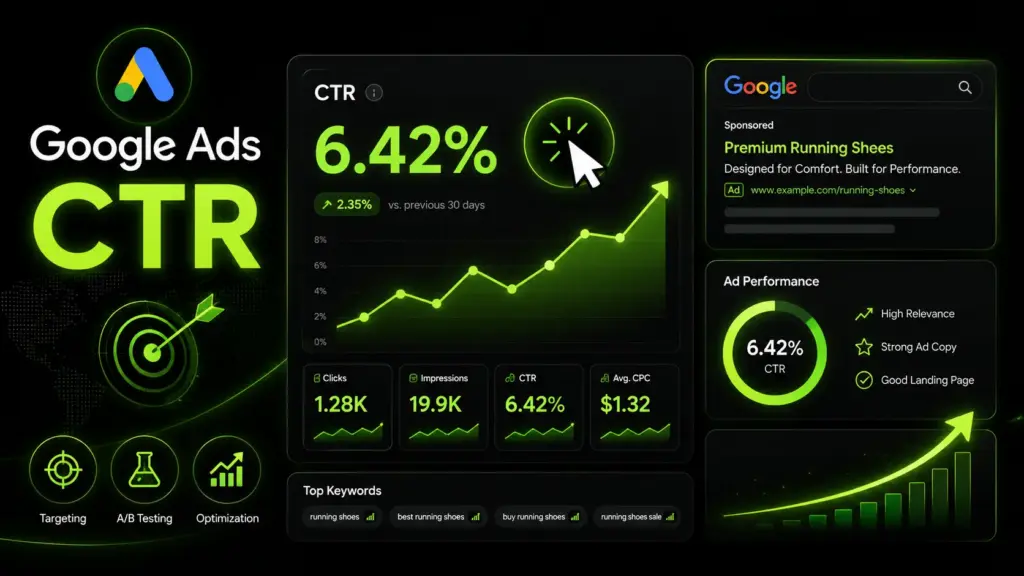
Google Ads CTR is the percentage of people who click your ad after seeing it. It is one of the clearest signals of whether your ad message, keyword targeting, and search intent are working together. A higher CTR often means your ad feels relevant to the user’s search, but it should never be judged alone. Strong PPC decisions come from reviewing CTR alongside conversions, cost per click, landing page quality, Quality Score, and overall Google Ads performance.
In this guide, you will learn what CTR means, what a good CTR looks like, and how to improve campaign results with better keywords, ad copy, targeting, and ongoing optimization.
What Is Google Ads CTR?
Google Ads CTR Meaning
Google Ads CTR means click-through rate in Google Ads. It measures how many people clicked your ad compared to how many people saw it.
For example, if your ad receives 100 clicks from 5,000 impressions, your CTR is 2%.
This metric helps advertisers understand whether their ad is attractive enough to earn attention. If many people see your ad but very few click, something may be wrong with your keyword targeting, headline, offer, or audience match.
Why Click Through Rate Google Ads Data Matters
Click through rate Google Ads data matters because it shows how well your ads connect with user intent. When a person searches on Google, they usually have a specific need. Your ad must prove quickly that it can help.
A strong CTR can indicate that:
- Your keywords match the search intent.
- Your headline is clear and relevant.
- Your offer is easy to understand.
- Your ad appears to the right audience.
- Your message stands out from competitors.
Low CTR does not always mean failure, but it is a useful warning sign. It tells you where to investigate before wasting more budget.
Why Google Ads CTR Matters for Performance
How Google Ads CTR Affects Ad Relevance
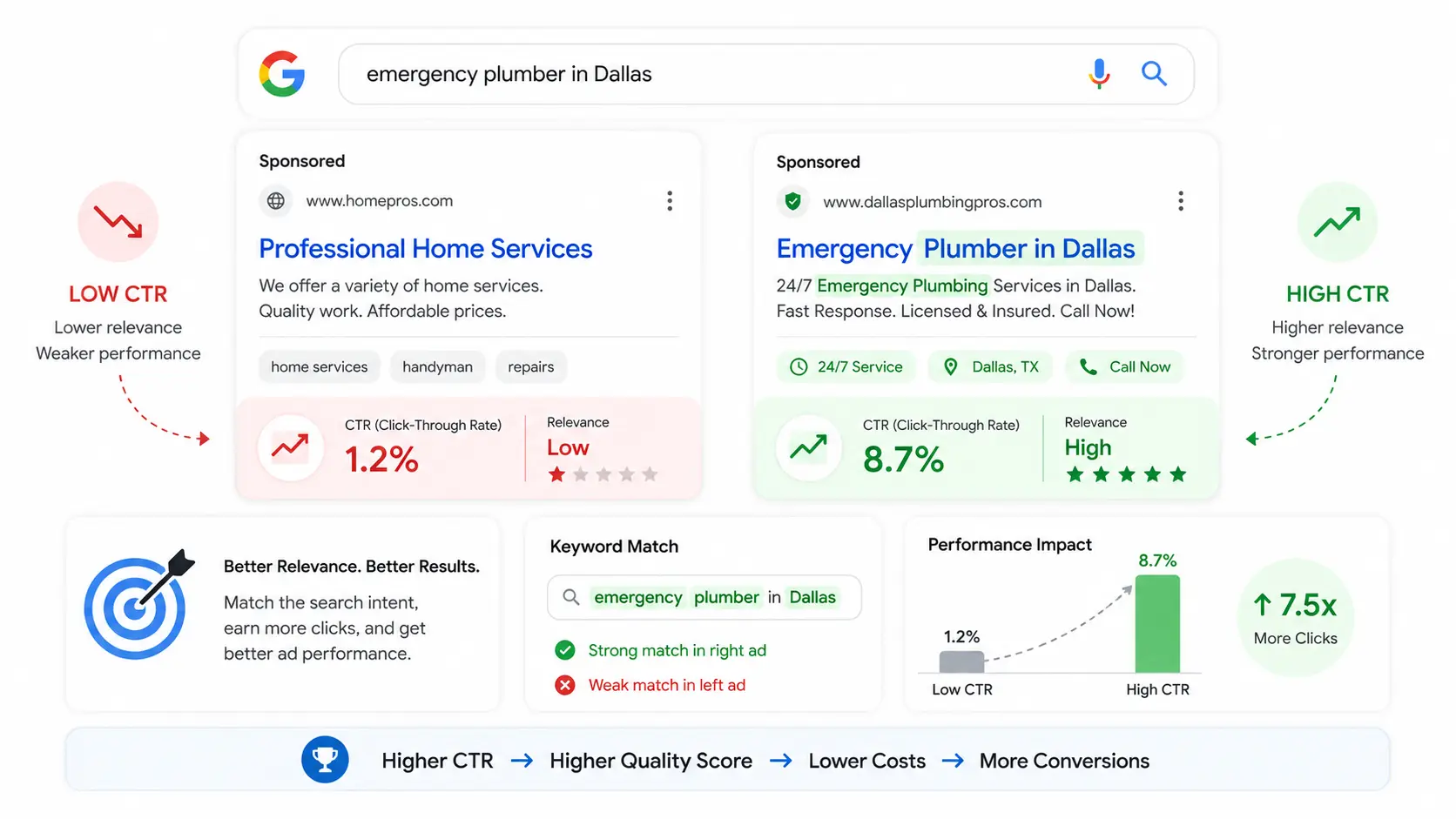
Google Ads CTR is closely connected to ad relevance. When users click your ad often, it usually means the ad matches what they were searching for. That relevance can support stronger campaign signals and help you understand which keywords and messages deserve more attention.
For example, an ad for “emergency plumber in Dallas” should not use a generic headline like “Professional Home Services.” A better headline would speak directly to the urgent search, such as “Emergency Plumber in Dallas.” The second version is more specific, more useful, and more likely to attract clicks.
For a deeper look at how relevance affects paid search results, read this guide on Google Ads Quality Score.
CTR Is Not the Only Google Ads Performance Metric
Google Ads performance should not be measured by CTR alone. A high CTR can look impressive, but it does not guarantee leads, sales, or profit. If people click your ad but leave the landing page without taking action, the campaign may still lose money.
Along with CTR, track:
- Conversion rate
- Cost per click
- Cost per conversion
- Return on ad spend
- Search terms
- Landing page experience
- Keyword quality
- Ad asset performance
The best campaigns balance clicks with business results. CTR tells you whether people are interested. Conversions tell you whether that interest is valuable.
What Is a Good CTR for Google Ads?
Average CTR Depends on Campaign Type
A good CTR depends on your industry, campaign type, keyword intent, competition, ad position, device, location, and offer. There is no single number that applies to every account.
Search campaigns usually have higher CTR than display campaigns because users are actively searching for something. Someone typing “book dentist appointment near me” has clearer intent than someone browsing a website and seeing a display ad.
Branded keywords often have higher CTR because users already know the business. Competitive non-branded keywords may have lower CTR because users compare several advertisers at once.
When a Low CTR Is a Warning Sign
A low CTR becomes a warning sign when your ads receive many impressions but very few clicks. This often means your ads are showing for searches that are too broad, too vague, or not closely connected to your offer.
Common causes include:
- Keywords are too broad.
- Ads do not match search intent.
- Headlines are weak or generic.
- Targeting is too wide.
- The offer is unclear.
- Competitors have stronger ad copy.
- Ad assets are missing.
- Landing page messaging feels disconnected.
The goal is not to chase clicks from everyone. The goal is to attract the right clicks from people most likely to become customers.
10 Best Ways to Improve Google Ads CTR
1. Use High-Intent Keywords
High-intent keywords are search terms that show the user is ready to compare, contact, book, buy, or request a quote. These keywords often create stronger CTR because they match a clear action.
For example, “roof repair cost” may be useful, but “roof repair company near me” shows stronger commercial intent. The second keyword is more likely to attract a click from someone ready to hire.
Choose keywords that match the stage of the buyer journey. Avoid targeting vague terms unless you have a clear strategy for awareness campaigns.
2. Remove Irrelevant Search Terms
Negative keywords are one of the simplest ways to improve traffic quality. They stop your ads from appearing for searches that do not match your business.
For example, if you sell premium accounting software, you may want to exclude words like “free,” “template,” or “course” if those searches do not convert.
Review your search terms regularly. Remove irrelevant traffic before it drains your budget and lowers CTR.
3. Write Stronger Headlines
Your headline is often the first thing users notice. It should match the search query, show a clear benefit, and give people a reason to click.
- Solving a problem
- Mentioning the exact service
- Adding location when relevant
- Highlighting speed or convenience
- Showing value or expertise
- Using a clear call to action
Instead of writing “Quality Marketing Services,” try “Google Ads Help for Small Businesses.” Specific headlines usually perform better because they reduce confusion.
4. Improve Google Ads CTR with Better Ad Copy
To improve Google Ads CTR, your descriptions must support the headline and answer the user’s intent quickly. The copy should explain what you offer, why it matters, and what the user should do next.
Avoid vague lines like “We provide great service.” Instead, write copy that connects to the searcher’s need: “Get clear PPC reporting, better keyword targeting, and campaign support built for lead generation.”
Good ad copy is not just creative. It is specific, useful, and aligned with the keyword.
5. Match Ads to Landing Pages
Users are more likely to click and convert when your ad promise matches the landing page. If your ad promotes “affordable Google Ads management,” the landing page should immediately explain that service.
A mismatch creates friction. People may click because the ad sounds useful, but they leave when the page does not deliver what they expected.
For small business campaign setup, this guide on Google Ads for small business can help you connect campaign structure with practical landing page planning.
6. Use Ad Assets
Ad assets make your search ads more useful and more visible. They can add extra links, business details, calls, locations, offers, and service highlights.
- Sitelinks
- Callouts
- Structured snippets
- Call assets
- Location assets
- Price assets
- Lead form assets
These additions give users more reasons to click. They also take up more space on the results page, which can help your ad stand out.
7. Segment Campaigns by Intent
Do not place very different keywords in the same ad group. When keyword intent is mixed, your ads become too generic.
For example, “PPC audit,” “Google Ads pricing,” and “hire PPC agency” may all relate to advertising, but each search has a different intent. One user wants an audit, another wants cost information, and another wants a service provider.
Segment campaigns or ad groups by service, product, location, or funnel stage. Better structure leads to better ad relevance.
8. Test Multiple Ad Variations
CTR improvement is rarely perfect on the first attempt. Testing helps you discover which message earns better engagement.
- Headlines
- Descriptions
- Calls to action
- Offers
- Benefit statements
- Location wording
- Emotional angles
Do not change everything at once. Test one meaningful difference so you can understand what caused the result.
9. Improve Targeting Settings
Poor targeting can lower CTR because your ads appear to people who are less likely to care. Review your settings carefully.
Check location targeting, device performance, language settings, audience segments, ad schedule, and demographics when relevant. A local service business may waste impressions if ads appear outside its service area. A B2B campaign may perform better during weekday business hours.
Better targeting helps your ads appear in front of users who are more likely to click and convert.
10. Review Campaign Data Regularly
Improving CTR is not a one-time task. Campaigns change as competitors update ads, search behavior shifts, and new keywords appear.
Review your data weekly or monthly depending on your budget and traffic volume. Look at search terms, keyword CTR, ad group performance, ad assets, conversion data, and landing page results.
Businesses that need ongoing support can explore PPC ads management services to keep campaigns monitored, tested, and improved over time.
Common Google Ads CTR Mistakes to Avoid
Using Too Many Broad Keywords
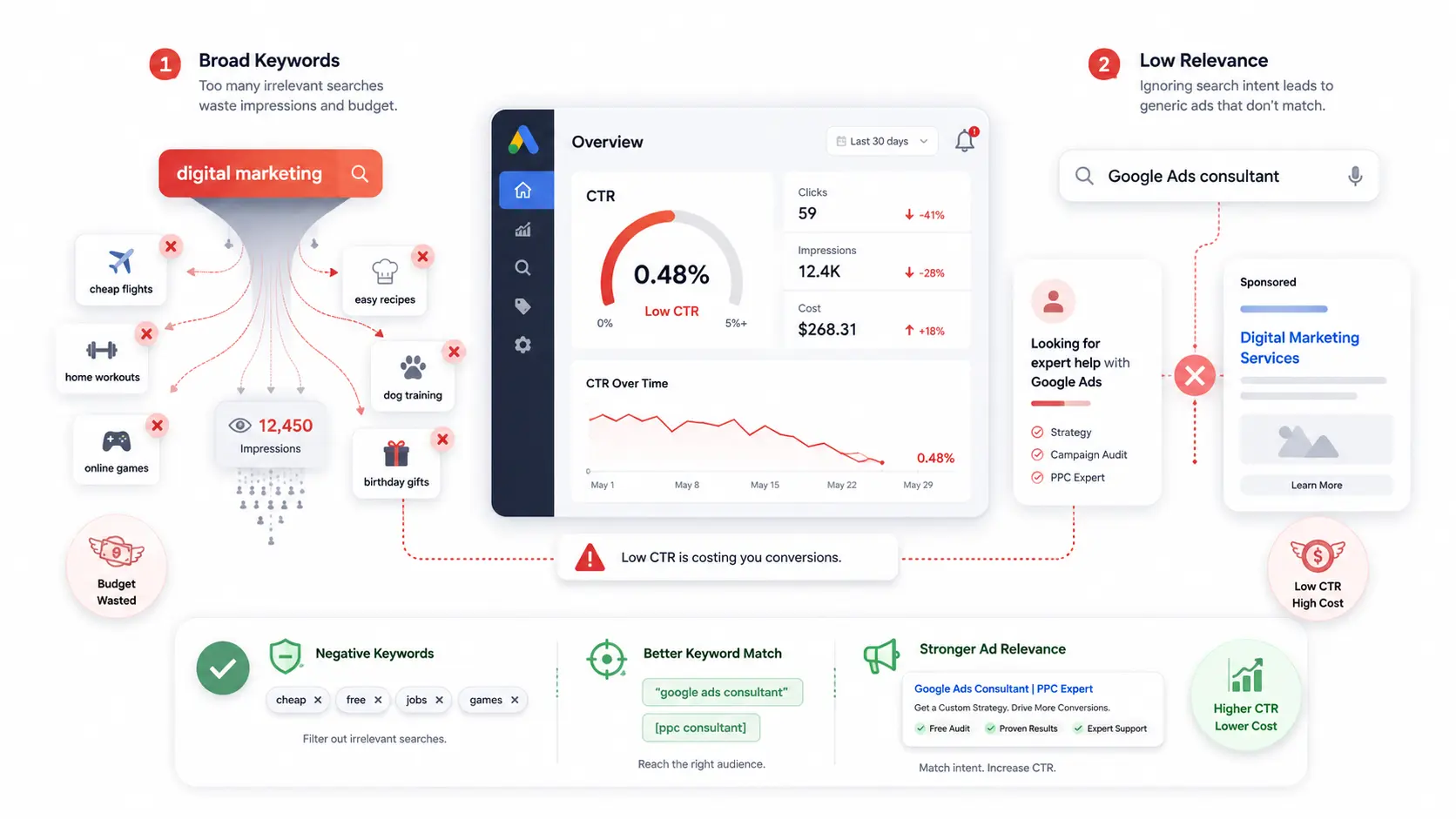
Broad keywords can generate many impressions, but they may reduce CTR if your ads appear for unrelated searches. More impressions are not always better. If the wrong people see your ads, fewer will click.
Use broad match carefully and review search terms often. Pair broader targeting with strong negative keyword lists and conversion tracking so you can control wasted spend.
Ignoring Ad Relevance
Even with good targeting, weak ad copy can reduce clicks. Generic ads do not stand out because they fail to match the user’s exact need.
Your ad should reflect the keyword, the problem, and the next step. If someone searches for “Google Ads consultant,” the ad should not sound like a general digital marketing service. Make the message specific enough to feel relevant immediately.
How to Track Google Ads CTR Properly
Check CTR by Campaign, Ad Group, and Keyword
Overall account CTR is helpful, but it can hide problems. One campaign may perform well while another quietly wastes budget.
Check CTR at different levels:
- Campaign level shows broad performance trends.
- Ad group level shows whether themes are organized correctly.
- Keyword level shows which searches attract clicks.
- Ad level shows which messages work best.
This layered view helps you find exactly where improvement is needed.
Compare CTR with Conversions
The goal is not only to get more clicks. The goal is to get clicks that lead to valuable actions.
Compare CTR with conversion rate and cost per conversion. A keyword with lower CTR may still be profitable if it brings strong leads. A keyword with high CTR may be poor if users click but never convert.
The best optimization decisions come from balancing engagement and revenue.
Final Thoughts on Google Ads CTR
Google Ads CTR is an important signal of ad relevance, search intent alignment, and campaign engagement. A strong CTR often means your keywords, headlines, descriptions, and targeting are working together. However, clicks alone do not define success.
To improve results, focus on high-intent keywords, negative keywords, stronger headlines, useful ad assets, better targeting, landing page alignment, and regular testing. When Google Ads CTR is reviewed alongside conversions and cost efficiency, it becomes a practical tool for improving paid search performance.
FAQs
What is Google Ads CTR?
Google Ads CTR is the percentage of users who click your ad after seeing it. It is calculated by dividing clicks by impressions and multiplying the result by 100. CTR helps advertisers understand how relevant and attractive their ads are to searchers. A higher CTR usually means the ad message, keyword, and search intent are closely aligned.
What is a good CTR for Google Ads?
A good CTR for Google Ads depends on your industry, campaign type, keyword intent, competition, and ad position. Search campaigns usually have higher CTR than display campaigns because users are actively looking for something. Instead of focusing only on averages, compare CTR with conversions, cost per click, and campaign profitability.
How can I improve Google Ads CTR?
You can improve Google Ads CTR by using high-intent keywords, writing stronger headlines, adding negative keywords, improving ad relevance, and using ad assets. Better targeting also helps because your ads appear to users who are more likely to click. Regular testing is important because small copy changes can improve performance over time.
Does high CTR always mean better Google Ads performance?
A high CTR is positive, but it does not always mean better Google Ads performance. If people click but do not convert, the campaign may still waste budget. CTR should be reviewed together with conversion rate, cost per conversion, Quality Score, landing page experience, and return on ad spend.
Why is my Google Ads CTR low?
Your Google Ads CTR may be low because your keywords are too broad, your ad copy is generic, or your targeting is not specific enough. Low CTR can also happen when the offer is unclear or the ad does not match the user’s search intent. Reviewing search terms and testing new ad copy can help identify the issue.