


What Are Long Tail Keywords?
Long tail keywords are longer, more specific search phrases people use when they want a clearer answer, product, service, or solution. Instead of searching for a broad term like "SEO," someone might search for "how to improve SEO for a small business website." That longer phrase gives you more information about what the person actually needs.
This is why long tail keywords are valuable for websites, blogs, service pages, and online stores. They may not always bring huge search volume individually, but they often attract visitors with stronger intent.
Long Tail Keywords vs Short Keywords
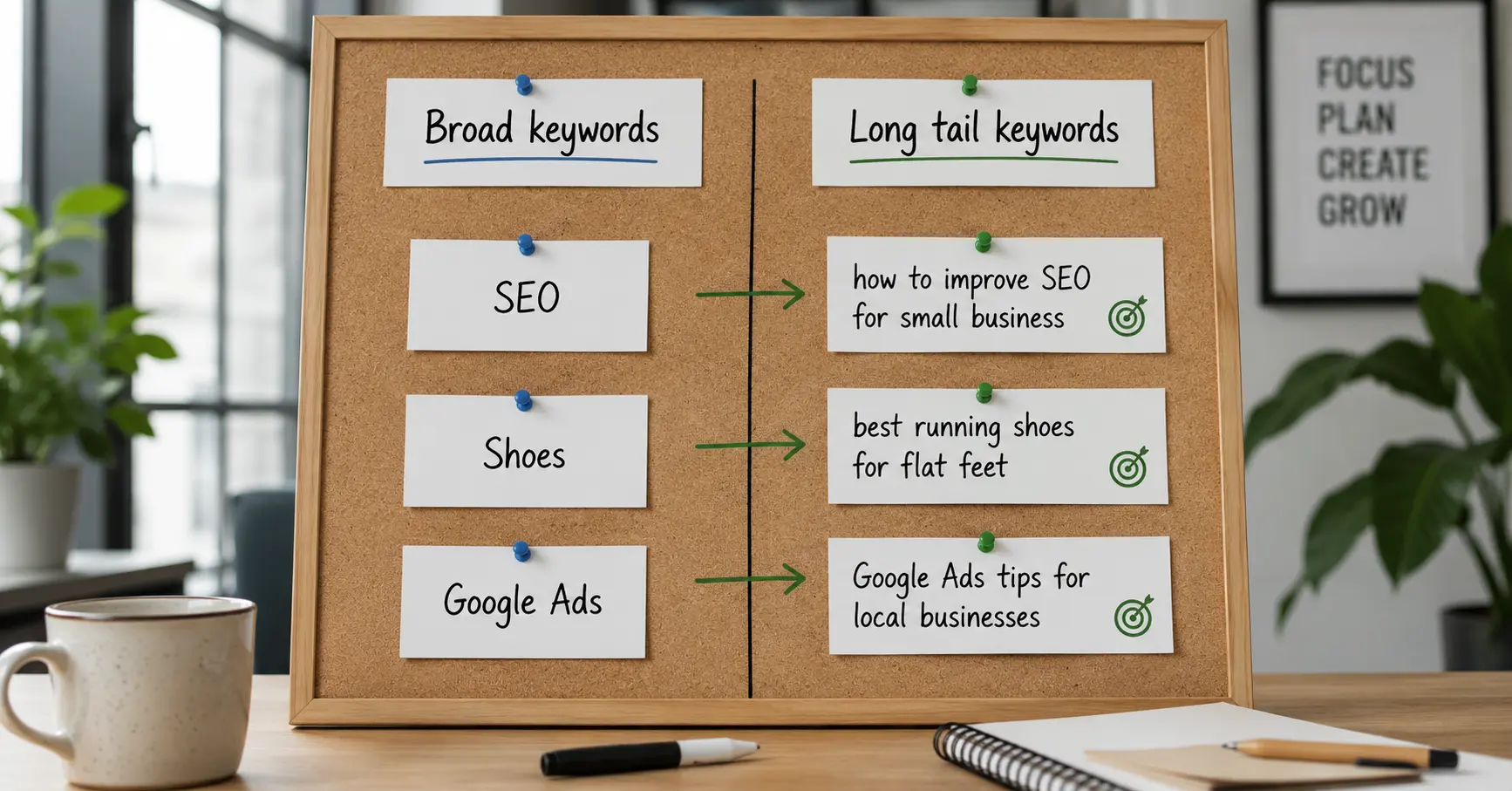
Short keywords are usually broad and competitive. Long tail keywords reveal specific search intent and offer more focused content opportunities.
- SEO
- shoes
- Google Ads
- keyword research
- how to improve SEO for small business
- best running shoes for flat feet
- Google Ads tips for local businesses
- how to find long tail keywords for blog
Longer search phrases are different because they reveal specific search intent. They often have lower competition, better conversion potential, and more focused content opportunities. This is why long tail keyword SEO strategies are useful for smaller websites trying to compete with larger brands.
Why Long Tail Keywords Are Important for SEO
Long tail keywords are important because they help you target people who already know what they are looking for. Instead of writing general content for everyone, you can create focused pages that answer specific questions.
How Long Tail Keywords SEO Helps Rankings
Long tail keywords can help newer websites rank faster because they are usually less competitive. A new blog may struggle to rank for "keyword research," but it may have a better chance with "how to find long tail keywords for blog posts." They also help you build topical authority — when your website covers many related search phrases around one subject, search engines can better understand your expertise.
You can use these keywords in blog posts, service pages, product pages, FAQ sections, comparison articles, and local landing pages.
How Long Tail Keywords Improve Conversions
People who use detailed searches usually have clearer intent. Someone searching "SEO" may only be exploring the topic. But someone searching "how to find long tail keywords for a new blog" has a specific problem and wants practical help. That matters because targeted visitors are more likely to read, subscribe, contact you, or buy.
Better traffic is not always more traffic. Fewer but more qualified visitors often produce better results than a high volume of uninterested clicks.
How to Find Long Tail Keywords for Your Website
Finding useful keyword ideas starts with understanding your audience. Do not begin with tools only — begin with the problems, questions, and goals your readers already have.
Start with Long Tail Keyword Research
Long tail keyword research helps you discover what your audience is actually searching for and how specific their needs are. Start with a broad topic, then expand it into more detailed search phrases. For example, if your topic is "content optimization," you can turn it into:
- how to optimize old blog posts for SEO
- content optimization checklist for beginners
- best content optimization tips for small websites
Understand Search Intent Before Choosing Keywords
Before choosing a keyword, ask what the searcher wants to do. The best keyword is not always the one with the highest volume — it is the one that matches your content goal and your reader's need.
User wants to learn something. Example: "what are long tail keywords"
User is comparing options. Example: "best keyword research tools"
User wants a specific brand, website, or tool. Example: "Ahrefs keyword explorer"
User is ready to take action. Example: "buy SEO audit service"
10 Easy Methods to Find Long Tail Keywords

How to Use Long Tail Keywords in SEO Content
Finding keyword ideas is only the first step. You also need to place them properly inside your content.
Add Long Tail Keywords to Titles and Headings
Use your main keyword in important SEO areas: SEO title, URL slug, H1, introduction, at least one H2 or H3, image alt text, meta description, and conclusion.
You can also support the main topic with internal links — for example, link naturally to related articles using anchors such as keyword mapping or an SEO audit checklist where they fit the reader's journey.
Use Keywords Naturally Without Stuffing
Do not repeat the same phrase too often. Search engines are better at understanding related language, so use natural variations such as keyword ideas, specific search terms, low-competition keywords, search phrases, and user queries. The content should sound helpful, not mechanical — answer the reader's question first and use SEO structure to make that answer easier to find.

Common Long Tail Keyword Mistakes to Avoid
Choosing Keywords Without Search Intent
Search volume alone is not enough. A keyword must match what the reader wants to learn or do. If your content does not satisfy intent, it may not perform well even if the keyword looks attractive.
Ignoring Low-Volume Keywords
Some long tail searches have low monthly volume, but they can still bring qualified traffic. When grouped inside a strong article, several low-volume phrases can support one useful, well-ranking page.
Creating Thin Content for Every Keyword
Do not create separate weak pages for very similar keyword variations. It is usually better to cover related search phrases in one detailed article than to publish many thin pages that dilute your authority.
Forgetting to Update Old Content
Old content can often improve with better headings, new examples, fresh FAQs, stronger internal links, and updated keyword targeting. Before creating a new article, check whether an existing page can be improved instead.
Long tail keywords help you understand what your audience really wants. Start with one broad topic, expand it into detailed questions, then build content that answers those searches clearly.
Need Help With Your SEO Content Strategy?
Get professional on-page SEO and content support to find the right keywords, build topical authority, and improve your search visibility.
View On-Page SEO Services →FAQs About Long Tail Keywords
Long tail keywords are longer and more specific search phrases that people use when they know what they are looking for. They usually have lower search volume than broad keywords, but they often have clearer intent. For SEO, they are useful because they can be easier to rank for and can attract more qualified visitors.
You can find them by using Google Autocomplete, People Also Ask, keyword research tools, competitor analysis, Google Search Console, and real customer questions. Start with a broad topic, then look for specific phrases that match your audience's needs.
Yes. They are good for SEO because they help websites target specific searches with less competition. They are especially useful for blog posts, service pages, and FAQ sections because they can improve rankings, bring targeted traffic, and support better conversion rates.
Use one main keyword and several related secondary keywords. The goal is not to repeat the same phrase many times, but to cover the topic naturally with helpful examples, related questions, subtopics, and keyword variations.
Short tail keywords are broad search terms, usually one or two words, such as "SEO" or "shoes." Long tail keywords are longer and more specific, such as "how to find long tail keywords for blog posts." Short keywords often have higher search volume, while longer phrases usually have clearer intent and lower competition.