
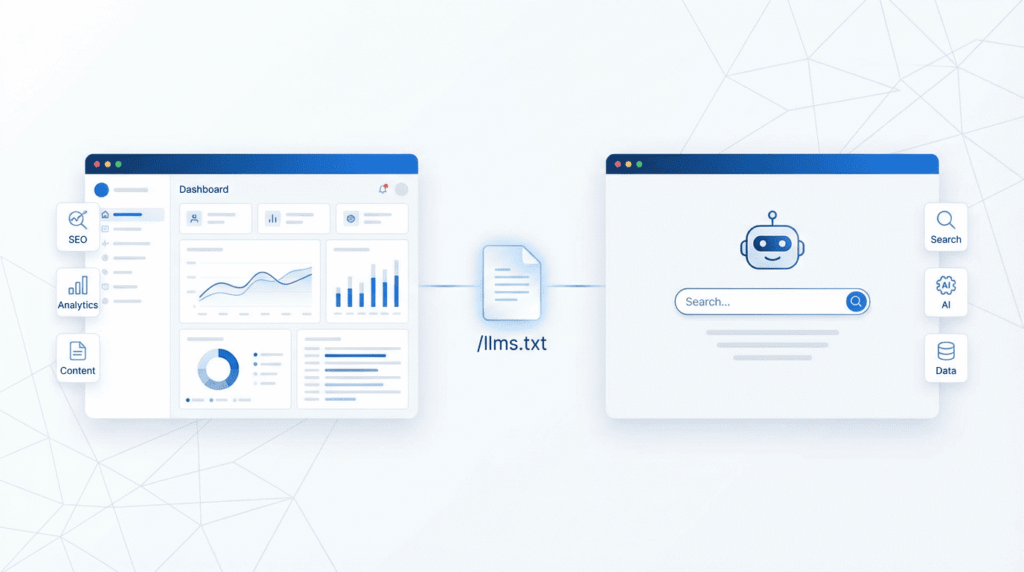
If you are wondering whether an llms.txt file is worth adding to your website, the practical answer is yes. It can help AI systems understand your most important pages faster, more clearly, and with less guesswork. It is not a magic ranking button — but a well-written llms.txt can improve content clarity, support AI search optimization, and make your site easier for both human teams and AI tools to interpret.
What Is an llms.txt File?
An llms.txt file is an emerging, proposed standard placed at the root of a website — usually at /llms.txt. Its purpose is to provide concise, LLM-friendly guidance about a site: what it's about, which pages matter most, and which topics or entities define the brand.
The proposal describes it as a Markdown file readable by both humans and language models, following a predictable structure for tooling.
AI systems often work better when they receive a compact, high-signal summary instead of having to infer everything from scattered navigation, boilerplate, and repetitive page chrome.
llms.txt vs robots.txt: What Changes?
This is one of the most common questions. These two files solve completely different problems — it is not an either-or decision.
Why Does llms.txt Matter Now?
Google's current guidance says there are no extra technical requirements needed to appear in AI Overviews or AI Mode. Pages simply need to be indexable and built with strong foundational SEO.
So why use llms.txt at all? Because AI search is broader than one search engine feature. AI assistants, answer engines, internal site agents, documentation tools, and retrieval systems can all benefit from a compact map of your key content.
The SEO benefit is usually indirect, not direct: better content organization, cleaner topical signals, stronger internal clarity, and easier reuse in AI-assisted discovery.
How to Create an llms.txt File
Keep it simple. Start with the information a machine actually needs — not marketing fluff. A good llms.txt file should be short, clear, factual, and easy to update.
What to include
- Brand or site name
- Short, plain-language description (1–2 lines)
- Key pages you want surfaced
- Major topics you genuinely cover
- Important entities and brand terms
- Optional: documentation hubs, contact & policy pages
Detailed llms.txt File Example
Below is a complete llms.txt example for a fictional content agency. Pull info from your homepage, service pages, and top content clusters — and never invent categories that don't exist on your site.
How to Prepare Content for AI Snippets SEO
The answer is not to chase robotic wording. It is to make your content easy to extract, verify, and summarize. A good AI-friendly section follows this pattern: direct answer → short explanation → example → next step.
Structure pages for AI snippets
Lead with the direct answer before any supporting detail or context.
Help both human readers and AI summarizers navigate your content easily.
One clear, precise sentence is far better than three vague ones.
Examples anchor abstract concepts and make claims verifiable.
AI systems extract meaning at the section level — don't bury the point.
Internal links signal topical depth and authority to AI retrieval systems.
AI snippet examples
An llms.txt file is a plain-text Markdown file placed at the root of a website to help large language models understand the site's purpose, important pages, topics, and entities. It does not replace robots.txt, but it can improve how AI systems interpret and prioritize your content.
To create llms.txt, add a Markdown file at /llms.txt with your brand name, a short site description, key URLs, major topics, and important entities. Keep the file concise, factual, and aligned with your main content and service pages.
7 SEO Wins from an llms.txt File
Let's be precise. An llms.txt file has no confirmed status as a Google ranking factor. But there are real, meaningful operational wins that compound over time.
Common Mistakes & Pre-launch Checklist
Mistakes that weaken your llms.txt
- ✕ Stuffing the file with keywords instead of factual summaries
- ✕ Listing every page on the site — prioritize ruthlessly
- ✕ Using sales copy or marketing fluff instead of clear descriptions
- ✕ Including topics you do not truly cover on the site
- ✕ Forgetting to update URLs when pages move or are renamed
- ✕ Creating a file that conflicts with your actual site navigation
- ✕ Assuming the file alone will improve rankings — it won't
Sites that benefit most
Pre-launch checklist
- File is placed at the root directory (/llms.txt)
- Description is one to two clear, factual lines
- Only priority pages are listed (not everything)
- Topics match real content clusters on your site
- Entities reflect your true expertise and brand
- Service pages answer questions directly
- H2 and H3 headings are descriptive and clear
- At least one AI-friendly answer block per key page
- Internal links point to deeper supporting resources
- Titles, meta descriptions, alt text, and slugs are clean
Build It Right, Not Just Fast
The llms.txt file is best treated as a practical clarity layer for the AI web — not a shortcut. Use it to summarize your site, spotlight core pages, and support stronger AI search optimization. Pair it with clean information architecture, helpful content, answer-first formatting, and solid on-page SEO. That is where the real gains happen.