
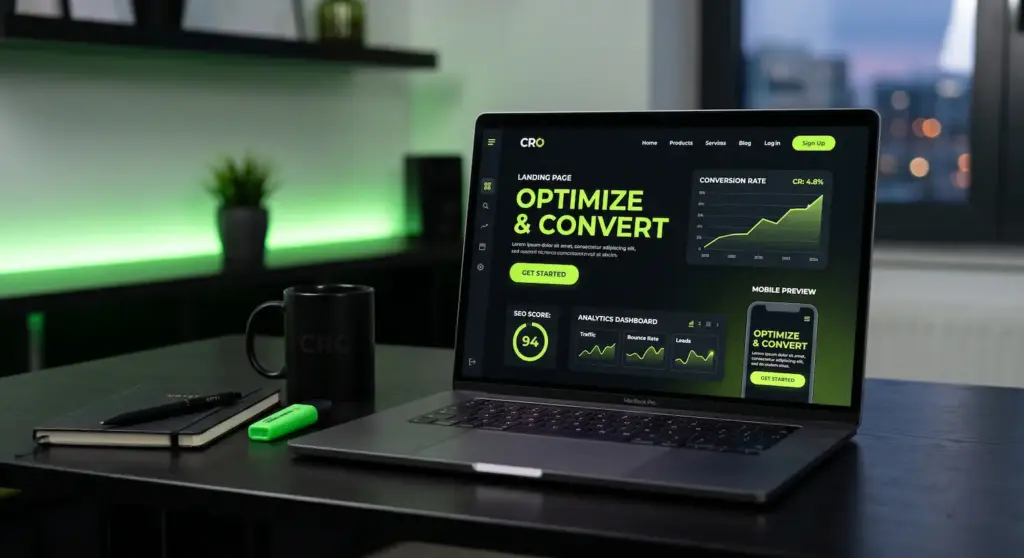
Landing page optimization is the process of improving a landing page so it performs better for users and search engines. It includes improving the headline, page copy, design, loading speed, mobile experience, call-to-action, form structure, trust signals, and keyword placement.
The goal is simple: help visitors understand the offer quickly and guide them toward one specific action. A strong landing page combines persuasive copy, fast performance, clean design, landing page SEO, and conversion rate optimization.
What Is Landing Page Optimization?
Landing page optimization means improving a page so more visitors complete the desired action — such as booking a call, submitting a form, downloading a guide, subscribing, or making a purchase.
How Landing Page Optimization Works
Landing page optimization works by making the page more focused and easier to use. Every section should support one goal. If the goal is to collect leads, the page should remove distractions and make the lead form simple. If the goal is to sell a product, the page should clearly explain the product's value and build trust.
| Page Element | Optimization Goal |
|---|---|
| Headline | Explain the main benefit quickly |
| Hero Section | Confirm visitors are in the right place |
| CTA Button | Tell users what to do next |
| Form | Make conversion easy |
| Trust Signals | Reduce doubt |
| Visuals | Support the offer |
| SEO Elements | Improve search visibility |
| Page Speed | Reduce drop-offs |
A strong landing page should also follow proper on-page SEO services principles, including optimized headings, clean metadata, internal links, and keyword-focused content.
Why Landing Page Optimization Matters
Landing page optimization matters because traffic alone does not create results. A page can receive hundreds or thousands of visitors, but if the message is unclear or the CTA is weak, many users will leave without taking action.
More traffic is not always the answer. Sometimes the fastest way to improve results is to increase the percentage of existing visitors who convert.
Better User Experience and Clearer Messaging
A strong landing page quickly answers three questions that every visitor has in their mind:
| Visitor Question | Landing Page Answer |
|---|---|
| What is this? | A clear headline and offer explanation |
| Why should I care? | Benefits, outcomes, and proof |
| What should I do next? | A visible and persuasive CTA |
Higher Conversion Rate Optimization Results
Conversion rate optimization focuses on improving the percentage of visitors who complete a desired action. Landing page optimization supports this by improving clarity, trust, layout, speed, and CTA strength.
| Without Optimization | With Optimization |
|---|---|
| Confusing headline | Clear benefit-driven headline |
| Multiple CTAs | One primary CTA |
| Long forms | Simple forms |
| Weak trust signals | Testimonials, reviews, proof |
| Slow page speed | Faster loading experience |
| Generic copy | Intent-focused copy |
Landing Page Optimization: 10 Best Ways to Increase Conversions
1. Define One Clear Goal for Each Landing Page
Every landing page should focus on one main goal. A page that asks visitors to book a call, download a guide, subscribe, and buy a product at the same time creates confusion. One page. One offer. One audience. One main action.
2. Write a Strong and Relevant Headline
The headline is one of the most important elements on the page. It should explain the benefit clearly and match the visitor's intent.
| Weak Headline | Strong Headline |
|---|---|
| Grow Your Business | Get More Qualified Leads With a High-Converting Landing Page |
| Best Marketing Solution | Improve Landing Page Conversions With Clear SEO Strategy |
| Welcome to Our Page | Turn More Visitors Into Customers |
3. Match the Page Content With Search Intent
Search intent is the reason behind a user's search. If someone searches for "landing page optimization," they want practical ways to improve page performance. The page should answer that need directly — not redirect to unrelated content.
4. Improve Page Speed and Mobile Experience
Slow landing pages lose visitors. Mobile experience is also essential because many users browse from smartphones. Compress and resize images before upload, keep layouts clean and lightweight, and make sure CTA buttons are easy to tap on small screens.
A landing page should be easy to read, scroll, tap, and complete on a mobile device.
5. Use One Clear Call to Action
A CTA tells visitors what to do next. It should be specific, visible, and connected to the offer. Place the main CTA above the fold and repeat it naturally throughout the page.
| Generic CTA | Better CTA |
|---|---|
| Submit | Get My Free Strategy |
| Click Here | Book a Free Consultation |
| Learn More | See How to Improve Conversions |
| Send | Request My Quote |
6. Add Trust Signals and Social Proof
Trust signals help visitors feel confident. They reduce doubt and make the offer feel safer. Use testimonials, reviews, case studies, client logos, certifications, and guarantees where they fit naturally. Visitors rarely convert when they feel uncertain.
7. Keep Forms Short and Simple
Forms should be easy to complete. Long forms often create friction, especially on mobile devices. Ask only for what you need — typically name and email for most lead generation pages. A simple form can improve conversion rate optimization because the action feels easier.
8. Use Visuals That Support the Offer
Visuals should support the page message. They should not distract from the CTA or slow down the page. Product screenshots show what the user gets, explainer graphics simplify complex ideas, and short videos can effectively explain a service or offer. Always use descriptive image alt text that includes your target keyword.
9. Test Headlines, CTAs, and Layouts
Testing helps you learn what works for your audience. You can test headlines, CTA buttons, page sections, forms, testimonials, and layouts. Test one major change at a time so you know what caused the result.
| Test Element | Example Test |
|---|---|
| Headline | Benefit-focused vs. problem-focused |
| CTA Button | "Book a Call" vs. "Get My Free Strategy" |
| Form Length | 3 fields vs. 5 fields |
| Hero Image | Screenshot vs. human image |
| Layout | Short page vs. detailed page |
10. Track Results and Improve Continuously
Landing page optimization should be ongoing. Track how users interact with the page and improve based on real data — conversion rate, bounce rate, scroll depth, CTA clicks, form submissions, and traffic source all tell you something useful.
How Landing Page SEO Improves Visibility
Landing page SEO helps search engines understand the page and helps users find it through relevant searches. A page built only for conversions but ignoring SEO may struggle to attract organic traffic.
A high-performing landing page should be useful for users and understandable for search engines.
Keyword Placement for Landing Page SEO
Use the main keyword naturally in important areas. Secondary keywords such as landing page SEO, conversion rate optimization, and landing page best practices should appear where they fit naturally.
| SEO Element | Recommendation |
|---|---|
| Title | Include the main keyword near the beginning |
| H1 | Match or closely follow the SEO title |
| First Paragraph | Mention the main keyword naturally |
| H2 | Include keyword in at least one H2 |
| URL Slug | Use landing-page-optimization |
| Image Alt Text | Add descriptive keyword-rich alt text |
| Body Content | Use keyword naturally, not repeatedly |
Meta Title, Meta Description, and Clean URL
| Element | Optimized Version |
|---|---|
| Meta Title | Landing Page Optimization: 10 Best Ways to Increase Conversions |
| Meta Description | Learn landing page optimization strategies to improve landing page SEO, boost conversions, and apply landing page best practices for better results. |
| URL Slug | landing-page-optimization |
Conversion Rate Optimization Tips for Landing Pages
Conversion rate optimization is about making it easier for visitors to take action. It focuses on clarity, trust, page flow, and user behavior.
How to Reduce Friction on the Page
Friction is anything that makes users hesitate. Keep sections clear, forms short, CTAs specific, and remove unnecessary links that pull visitors away from the goal.
| Friction Problem | Better Solution |
|---|---|
| Too much text | Use clear sections and short paragraphs |
| Long forms | Ask only for essential details |
| Slow loading | Compress images and reduce scripts |
| Weak CTA | Use specific action-focused copy |
| No proof | Add testimonials or reviews |
| Too many links | Keep users focused on one goal |
How to Make CTAs More Persuasive
Strong CTA copy should tell users what they get, not just what action they take. A CTA should feel like a helpful next step — not a demand.
| Weak CTA | Persuasive CTA |
|---|---|
| Submit | Get My Free Strategy |
| Contact Us | Book a Free Consultation |
| Download | Download the Landing Page Checklist |
| Start | Start Improving Conversions |
Landing Page Best Practices to Follow
Landing page best practices help create pages that are easy to understand, search-friendly, and conversion-focused. If you run paid campaigns, professional PPC management services can help align ad copy, audience targeting, and landing page messaging for better conversion results.
Best Practices for Design
| Design Element | Best Practice |
|---|---|
| Layout | Keep the page clean and focused |
| White Space | Use spacing to improve readability |
| CTA Placement | Put the main CTA above the fold |
| Fonts | Use readable font sizes |
| Colors | Make CTA buttons stand out |
| Visual Hierarchy | Guide users from headline to CTA |
Best Practices for Content and Copy
| Content Element | Best Practice |
|---|---|
| Headline | Lead with the main benefit |
| Subheading | Explain the offer clearly |
| Benefits | Show why the offer matters |
| Features | Support the benefits with specifics |
| Proof | Add testimonials, reviews, or results |
| CTA Copy | Make the next step clear |
Landing Page Best Practices Checklist
- Use one clear offer per landing page
- Keep the headline short and benefit-driven
- Place the main CTA above the fold
- Optimize the page for mobile users
- Use trust signals such as testimonials or reviews
- Keep forms simple and easy to complete
- Add relevant keywords naturally
- Improve page speed and loading performance
- Test different headlines, buttons, and layouts
- Track conversions and user behavior regularly
Common Landing Page Optimization Mistakes
Even good-looking landing pages can fail when they are not focused on user intent and conversion behavior.
Using Too Many Goals on One Page
A landing page should not act like a homepage. It should not promote every service, blog post, social profile, and offer at the same time. Multiple CTAs confuse visitors. Too many links send users away from the goal. An unclear offer reduces trust.
Ignoring Mobile, Speed, and User Intent
| Mistake | Better Approach |
|---|---|
| Desktop-only design | Build mobile-first sections |
| Heavy images | Compress and resize visuals |
| Keyword stuffing | Write naturally for users |
| Generic messaging | Match search intent |
| No analytics | Track performance regularly |
A landing page can look professional and still fail if it loads slowly, ignores mobile users, or does not match visitor intent.
Final Thoughts
Landing page optimization helps businesses turn traffic into leads, customers, subscribers, and sales. A strong landing page is focused, fast, clear, trustworthy, and easy to act on. The best pages combine landing page SEO with conversion rate optimization — they attract the right visitors and guide them toward the right action.
Landing pages should be reviewed regularly. If traffic drops, rankings decline, or conversions slow down, it may be time to update the copy, CTA, design, technical SEO, or page layout. Landing page optimization is not a one-time task. The best results come from testing, tracking, and improving the page based on real user behavior.
Need Help Optimizing Your Landing Pages?
Get professional on-page SEO and PPC support to improve your landing page performance and drive more conversions.
View On-Page SEO Services →Frequently Asked Questions
Landing page optimization is the process of improving a landing page so it performs better for users and search engines. It includes improving the headline, content, design, page speed, call-to-action, mobile experience, and overall user flow. The goal is to help visitors understand the offer quickly and take the desired action.
Landing page optimization is important because it helps turn more visitors into leads, customers, or subscribers. A poorly optimized page may receive traffic but fail to generate results. With better structure, clearer messaging, stronger CTAs, and improved landing page SEO, businesses can improve both visibility and conversions.
You can improve conversion rate optimization by making the page focused, fast, and easy to understand. Use a clear headline, one strong CTA, short forms, trust signals, and relevant visuals. Testing different page elements such as button text, layout, and copy can also help identify what converts best.
The best landing page SEO practices include using the main keyword naturally, writing an optimized SEO title and meta description, creating a clean URL, improving page speed, adding internal links, using descriptive image alt text, and matching the content with search intent. The page should be useful, focused, and easy to navigate.
Landing pages should be reviewed regularly, especially when traffic, rankings, or conversions start to drop. It is useful to update copy, CTAs, visuals, keywords, and technical elements based on performance data. Continuous testing and improvement help keep the page relevant, competitive, and effective over time.