
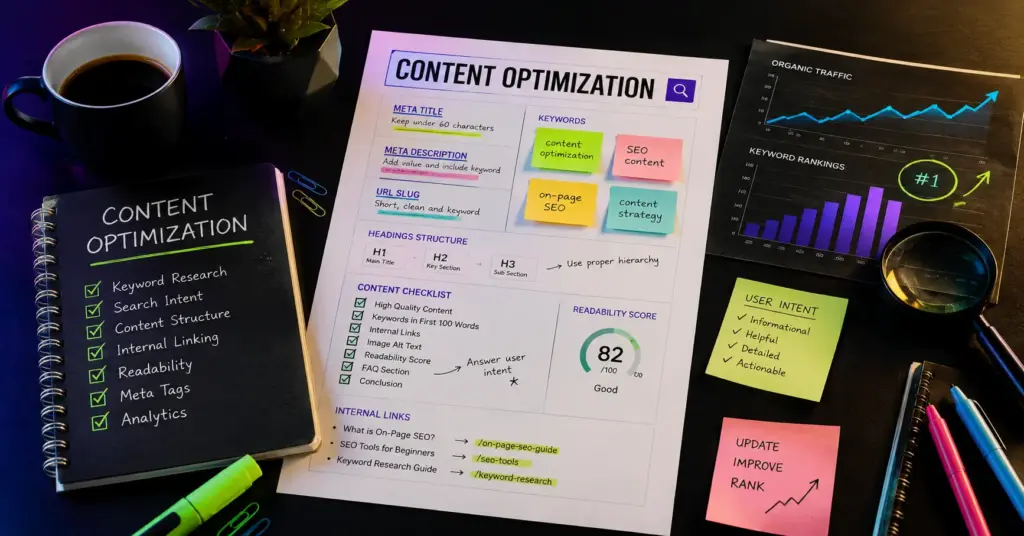
Content optimization is the process of improving website content so it performs better in search engines and gives readers a better experience. It includes keyword placement, search intent, headings, internal links, images, metadata, readability, and regular content updates.
When done correctly, content becomes easier for search engines to understand and more useful for visitors. The goal is not to stuff keywords into a page — it is to create clear, helpful, well-structured content that answers the user's question better than competing pages.

What Is Content Optimization?
Content Optimization Meaning
Content optimization means improving written, visual, and technical content elements so a page can attract the right audience, rank better, and provide useful information. A well-optimized page is structured so real users can quickly understand the topic, find answers, and take the next step.
It usually includes:
- Keyword placement and search intent alignment
- Clear headings and logical content structure
- Internal links and meta title / meta description
- Image alt text and readability improvements
- Content freshness, helpful examples, and FAQs
Why Content Optimization Is Important for SEO
Even strong content can underperform if it is poorly structured, missing important keywords, hard to read, or not aligned with search intent. Good optimization makes a page more relevant, more useful, and easier to rank. Content needs to satisfy both search engines and readers — search engines use page signals to understand relevance, and readers use structure and clarity to decide whether the content is helpful.
Why Content Optimization Matters for SEO
Content optimization matters because it closes the gap between what you publish and what users actually need. A page that answers the right question clearly, in the right format, with the right keywords, has a much stronger chance of ranking and converting than one that only ticks a few SEO boxes.
Rankings alone are not the goal. The goal is content that earns clicks, keeps readers engaged, and drives meaningful action — optimization is what makes that happen consistently.
How to Optimize Content for SEO
Start with Search Intent
Before writing or updating a page, understand what the searcher wants. Someone searching for "content optimization" likely wants a beginner-friendly guide, practical steps, tools, a checklist, and answers to common SEO questions. Matching search intent is one of the most important parts of SEO content optimization — if the page does not answer the right question, better keywords alone will not fix it.
User wants to learn something. Example: "what is content optimization"
User is comparing options. Example: "best content optimization tools"
User is ready to take action. Example: "buy SEO content writing service"
User wants a specific brand. Example: "Semrush content analyzer"
Use Keywords Naturally
Start with natural keyword placement. Use the main keyword and secondary keywords where they help search engines and readers understand the page. Avoid keyword stuffing — keep keyword usage below 2% and focus on clarity, usefulness, and complete answers.
Place the main keyword in these areas:
10 Best Ways to Improve SEO Rankings with Content Optimization


Best Content Optimization Tools for Better Website Performance
The best content optimization tools help with research, writing, auditing, and tracking. The right choice depends on your goal — some tools are better for keyword research, others for content scoring, technical checks, competitor analysis, or performance tracking.
Do not use tools blindly. A high score does not always mean the content is helpful. The final content should still sound natural, answer search intent, and provide real value to the reader.
Content Optimization Checklist Before Publishing
- Main keyword appears in the SEO title
- Main keyword appears in the meta description
- Main keyword appears in the URL slug
- Main keyword appears in the first 100 words
- Main keyword appears in at least one H2
- Main keyword appears in at least one H3
- Secondary keywords are used naturally throughout
- Article answers the main search intent
- Headings are clear, logical, and well-structured
- Internal links are added naturally
- Image alt text is optimized with descriptive text
- Paragraphs are short and easy to read
- FAQ section is included
- Content is original, useful, and complete
- No keyword stuffing or repetitive phrasing
Common Content Optimization Mistakes
The most common mistakes include overusing the main keyword, ignoring search intent, writing thin content, forgetting internal links, using weak titles, missing image alt text, and not updating old content. Another mistake is writing only for search engines — readers decide whether the page is actually useful. Helpful content should be clear, complete, and easy to act on.

Final Thoughts on Content Optimization
Content optimization is one of the most important parts of SEO because it improves visibility, readability, relevance, and conversions. Strong results come from combining keyword strategy, helpful writing, clear headings, natural internal links, optimized images, useful FAQs, and regular updates.
The best approach is simple: understand what users want, create content that answers the topic fully, structure it clearly, and keep improving it over time. When content optimization is done naturally, your pages become easier to find, easier to read, and more valuable for both search engines and real visitors.
Need Help Optimizing Your Website Content?
Get professional on-page SEO and content writing support to improve rankings, readability, and conversions across your most important pages.
View On-Page SEO Services →FAQs About Content Optimization
Content optimization in SEO is the process of improving website content so it can rank better in search engines and provide more value to readers. It includes keyword placement, search intent, headings, internal links, image alt text, meta tags, readability, and content quality. The goal is to make the page easier to understand and more competitive in search results.
To optimize content for SEO, start by understanding search intent and choosing relevant keywords. Then improve the title, headings, URL, meta description, internal links, image alt text, and readability. The content should answer the user's question clearly, avoid keyword stuffing, and include helpful details that make the page more complete than competing results.
The best content optimization tools depend on your needs. Keyword research tools help find search opportunities, SEO audit tools identify technical issues, and content scoring tools suggest improvements. Popular options include tools for keyword analysis, content gaps, readability checks, search performance tracking, and page-level SEO audits.
Content optimization is important because search engines need clear signals to understand what a page is about. Well-optimized content also improves user experience by making information easier to read and navigate. When content matches search intent, includes helpful details, and follows SEO best practices, it has a better chance of ranking higher.
Optimized content should be reviewed regularly, especially if rankings drop, traffic decreases, or the topic changes. For important SEO pages, reviewing content every three to six months is a good practice. Updates can include adding new information, improving headings, refreshing keywords, fixing broken links, and expanding weak sections.