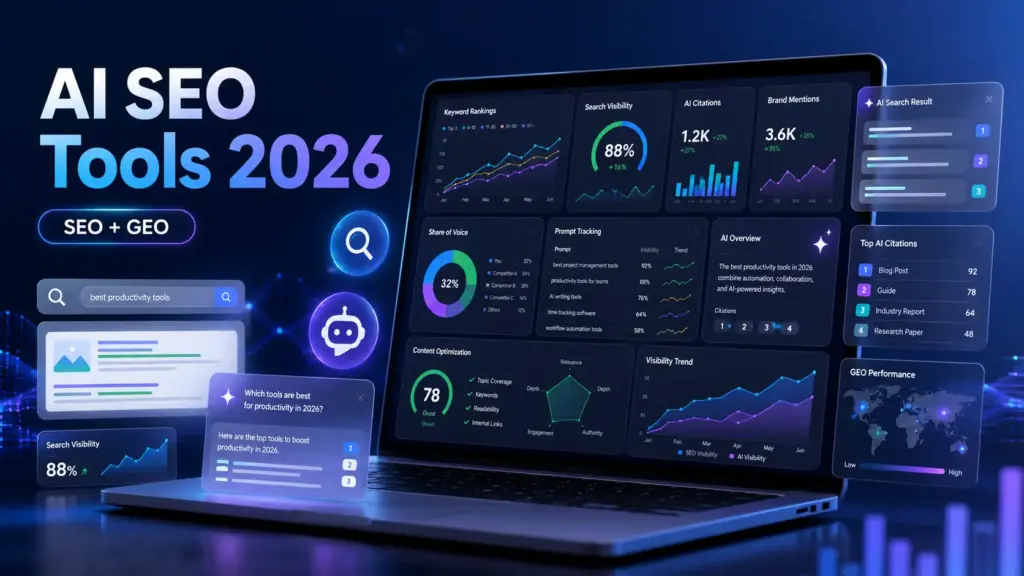
The best AI SEO tools 2026 help businesses improve traditional search rankings while also measuring how their brands appear in ChatGPT, Google AI Overviews, AI Mode, Gemini, Perplexity, and other answer engines.
Semrush and Ahrefs are the strongest all-around choices for businesses that need traditional SEO research combined with AI visibility data. Surfer, Frase, Clearscope, and MarketMuse are better suited to content optimization, while Writesonic, OtterlyAI, Peec AI, and SE Ranking offer more focused GEO and AI search tracking capabilities.
The right platform depends on whether your main priority is keyword research, content production, technical SEO, competitor analysis, AI citations, brand mentions, or a combination of these activities.
What Are AI SEO Tools?
AI SEO tools are platforms that use artificial intelligence, machine learning, natural language processing, or automated data analysis to support search engine optimization.
They can help marketers:
- Research keywords and search intent
- Analyze competitors
- Create content briefs
- Optimize articles
- Find content gaps
- Audit technical SEO issues
- Suggest internal links
- Track rankings
- Monitor AI-generated answers
- Measure brand mentions and citations
- Compare AI share of voice against competitors
Traditional SEO software primarily measured rankings, backlinks, traffic, and technical performance. Modern platforms must also measure whether brands are being discussed or cited inside AI-generated answers.
What Is the Difference Between SEO and GEO Tools?
Traditional SEO tools focus on increasing visibility in search engine results pages. They measure signals such as keyword rankings, organic traffic, backlinks, indexed pages, and technical health.
GEO tools focus on visibility inside generative search experiences. They monitor whether a brand or website appears in answers produced by platforms such as ChatGPT, Gemini, Perplexity, and Google AI Overviews.
The two disciplines overlap, but they are not identical. A page can rank well in Google without being frequently cited by AI systems. A brand can also be mentioned in AI answers even when its own website is not the cited source.
For a deeper explanation, see the comparison between AI search optimization and traditional SEO.
Why Businesses Need Both SEO and GEO Data
Google rankings remain important because search engines still generate traffic, leads, and sales. However, users increasingly receive recommendations and summarized answers without reviewing a standard list of links.
A modern search strategy should therefore answer two questions:
- Does the website rank for valuable searches?
- Is the brand mentioned or cited when users ask AI platforms related questions?
Using traditional SEO and GEO data together provides a more complete picture of online visibility.
How AI SEO Software Has Changed in 2026
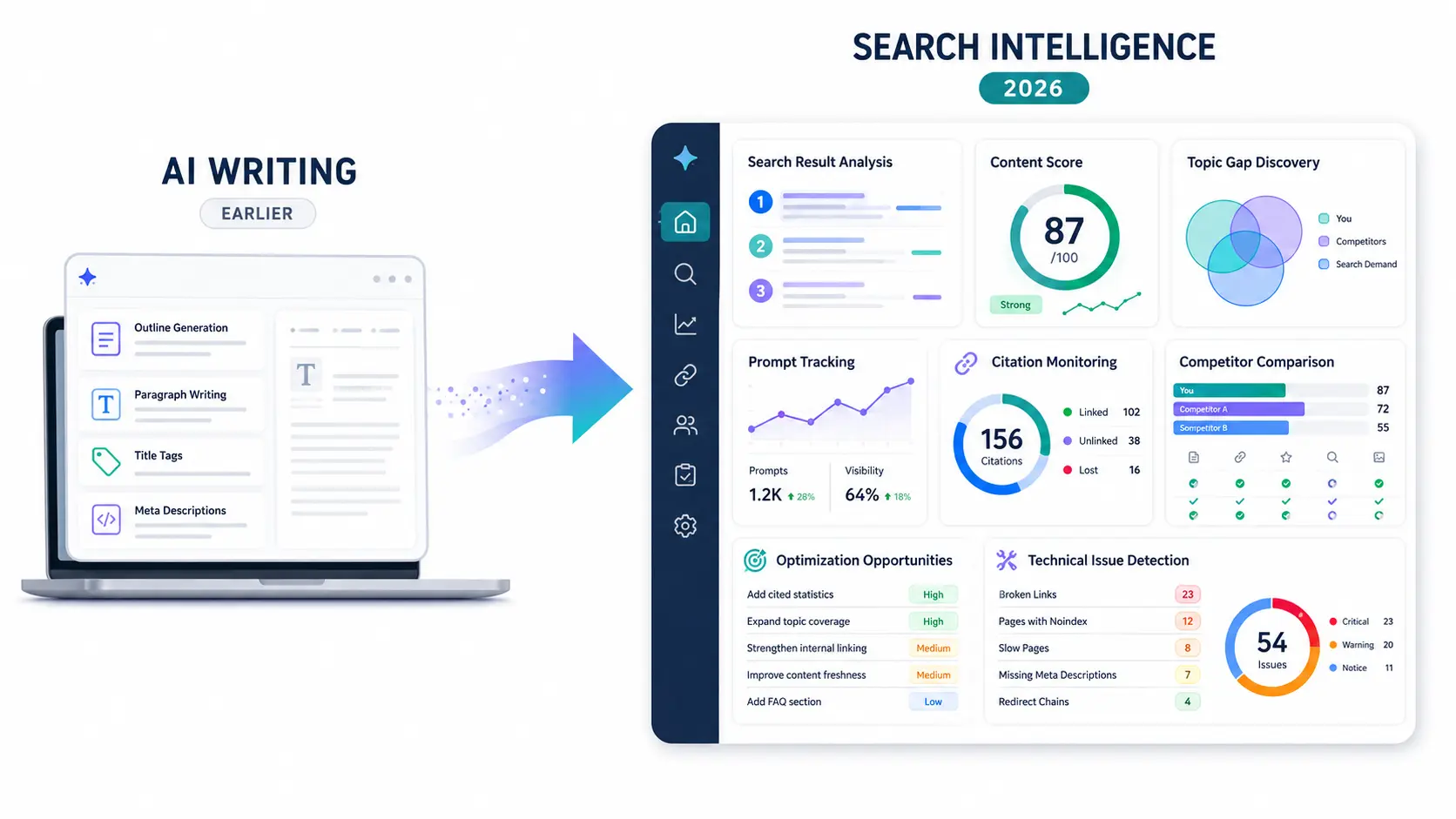
Earlier AI SEO tools were mainly writing assistants. They generated outlines, paragraphs, title tags, and meta descriptions.
The leading platforms in 2026 perform a much wider range of tasks. They can analyze search results, score content, discover missed topics, track prompts, monitor citations, compare competitors, and prioritize optimization opportunities.
From AI Writing to Search Intelligence
Content generation remains useful, but producing more text is no longer enough. Businesses need systems that can decide:
- Which topics deserve content
- Which pages should be updated
- Which questions customers are asking
- Which sources AI engines frequently cite
- Which competitors dominate important prompts
- Which technical issues prevent content discovery
This is why the strongest platforms combine creation with research, measurement, and optimization.
Businesses using AI for content production should still maintain editorial control, factual review, and a distinct brand voice. The guide to AI writing tools for content marketing explains how these systems fit into a controlled content workflow.
From Keywords to Prompts and Citations
Keyword rankings are relatively straightforward: a domain appears in a measurable position for a search query.
AI answers are more variable. Results may change by platform, location, prompt wording, model, and date. GEO platforms therefore use metrics such as:
- Brand visibility
- Mention frequency
- Website citations
- Share of voice
- Average mention position
- Sentiment
- Cited pages
- Competitor coverage
- Prompt coverage
- Visibility trends
These metrics do not replace rankings. They add another measurement layer.
Best AI SEO Tools 2026 Comparison
| Tool | Best For | Traditional SEO | Content Optimization | AI Visibility Tracking |
|---|---|---|---|---|
| Semrush | Complete SEO and GEO management | Strong | Strong | Strong |
| Ahrefs | SEO research and large-scale AI visibility | Strong | Moderate | Strong |
| Surfer | Content optimization with AI tracking | Moderate | Strong | Strong |
| Writesonic | GEO execution and AI content workflows | Moderate | Strong | Strong |
| Frase | SEO and GEO content production | Moderate | Strong | Moderate |
| OtterlyAI | Affordable AI search monitoring | Limited | Moderate | Strong |
| Peec AI | AI search analytics for marketing teams | Limited | Limited | Strong |
| SE Ranking | Agencies combining rank and AI tracking | Strong | Moderate | Strong |
| Clearscope | High-quality editorial optimization | Limited | Strong | Moderate |
| MarketMuse | Content strategy and topical authority | Moderate | Strong | Limited |
| SEO.AI | Automated SEO content production | Moderate | Strong | Limited |
| Semrush Enterprise AIO | Enterprise AI visibility intelligence | Moderate | Limited | Strong |
No single tool is best for every business. The most useful choice depends on the work that needs to be completed and the metrics that decision-makers expect to see.
The 12 Best AI SEO Tools 2026
01 Semrush: Best Overall AI SEO and GEO Platform
Semrush is one of the most complete options for businesses that want to manage traditional SEO and AI visibility within the same ecosystem.
Its traditional toolkit supports keyword research, competitor analysis, backlinks, technical audits, content planning, position tracking, and reporting. Its AI visibility capabilities add brand mentions, cited pages, citations, prompt research, competitor comparisons, and platform-level visibility.
Best for:
- In-house marketing departments
- SEO agencies
- Multi-market brands
- Businesses replacing several separate tools
- Teams that need executive reporting
Semrush is especially useful when SEO and GEO are managed by the same department. Teams can connect ranking opportunities with AI visibility gaps instead of reviewing each channel in isolation. The main disadvantage is complexity — smaller businesses may not use enough of the platform to justify a broad subscription.
02 Ahrefs: Best for SEO Research and Broad AI Visibility
Ahrefs remains particularly strong for backlink research, competitor analysis, keyword discovery, site auditing, and organic traffic analysis.
Its Brand Radar functionality expands the platform into AI search monitoring. It can help teams examine mentions, citations, impressions, AI share of voice, cited pages, and competitor visibility across major AI platforms.
Best for:
- SEO professionals
- Link-building teams
- Competitive researchers
- Brands monitoring broad category visibility
- Businesses that want SEO and AI citation data together
Ahrefs is valuable for identifying the websites and pages that influence AI answers, which can support content planning, digital PR, link acquisition, and partnership outreach. It is a strong choice for research-heavy teams, although businesses focused mainly on content writing may prefer a dedicated optimization editor.
03 Surfer: Best AI SEO Tool for Content Optimization
Surfer is designed for writers and SEO teams that want data-guided content optimization.
Its editor analyzes competing pages and recommends relevant terms, subjects, headings, and content adjustments. The platform can also support audits, content generation, internal linking, and AI visibility monitoring. Surfer's AI Tracker makes it more useful for GEO by measuring brand mentions, visibility, competitors, citations, sources, and prompt performance across supported AI environments.
Best for:
- Blog teams
- Freelance SEO writers
- Content agencies
- Publishers updating existing articles
- Teams that want SEO scoring and AI monitoring
Surfer works best when a business already knows which keywords and pages it wants to target. It is more focused on improving content than replacing a complete enterprise SEO suite.
04 Writesonic: Best GEO Tool for Turning Insights Into Action
Writesonic has developed from an AI writing platform into a broader SEO and GEO system.
It can track AI visibility, mentions, citations, competitor market share, platform performance, content gaps, and citation opportunities. Its content capabilities can then help teams create or update pages based on those findings.
Best for:
- Teams building a GEO program
- SaaS companies
- Content marketers
- Businesses managing several brands
- Marketers who want monitoring and execution together
One of Writesonic's main advantages is the connection between measurement and action — instead of only showing that a competitor is being cited, it can help identify content and optimization opportunities. It is still important to review generated material carefully; automated content should support expertise rather than replace it.
05 Frase: Best for SEO and GEO Content Workflows
Frase combines search-result research, brief creation, content writing, optimization, and GEO scoring.
Its editor can evaluate traditional SEO relevance while also assessing qualities that make content easier for AI systems to understand and reuse. These include clear structure, direct answers, topical coverage, and authoritative presentation.
Best for:
- Content managers
- SEO writers
- Small and midsized agencies
- Teams producing detailed informational content
- Businesses that want structured briefs
Frase is particularly effective for turning research into an article outline, reducing the time required to examine search results and determine which questions or subjects need to be included. It is less suitable as a standalone technical SEO or backlink platform.
06 OtterlyAI: Best Affordable AI Search Monitoring Tool
OtterlyAI focuses on tracking brand mentions, website citations, prompts, competitors, share of voice, and visibility across major AI search platforms.
It is one of the more accessible options for businesses that want to begin measuring GEO performance without purchasing a large traditional SEO suite.
Best for:
- Small businesses
- Independent consultants
- Specialist GEO agencies
- Brands testing AI visibility monitoring
- Teams that need citation reports
OtterlyAI can also help identify which external sources are frequently used in AI answers, giving marketers ideas for content updates, media outreach, digital PR, and community participation. Its limitation is that it does not replace a complete keyword, backlink, or technical SEO toolkit.
07 Peec AI: Best for Clear AI Search Analytics
Peec AI is built around three important AI search metrics: visibility, position, and sentiment.
The platform helps marketing teams monitor whether their brand appears in AI answers, how prominently it is presented, how competitors perform, and whether the description is positive, neutral, or negative.
Best for:
- Brand teams
- Marketing departments
- Reputation managers
- SaaS businesses
- Teams that need simple GEO reporting
Peec AI is appealing because its reporting model is relatively easy to communicate — executives may understand brand visibility and sentiment more quickly than a complicated set of technical SEO metrics. However, businesses will usually need another platform for keyword research, backlinks, and detailed website audits.
08 SE Ranking: Best for Agencies Managing SEO and AI Visibility
SE Ranking provides rank tracking, keyword research, competitor analysis, website auditing, backlink tools, reporting, and AI search monitoring.
Its AI tracking capabilities can monitor brand mentions, sources, competitors, prompts, and visibility trends across major AI and Google-generated search experiences.
Best for:
- SEO agencies
- Consultants
- Small and midsized businesses
- Teams requiring client reports
- Users seeking an alternative all-in-one suite
SE Ranking offers a practical middle ground between traditional SEO platforms and specialist GEO products. Agencies can use it to show both ranking changes and emerging AI visibility metrics, though it may not offer the same research depth as the largest enterprise suites.
09 Clearscope: Best for Editorial Quality and Content Relevance
Clearscope helps writers improve content relevance, readability, topical coverage, and search intent alignment.
Its editor evaluates competing content and presents recommendations without forcing writers into an overly automated workflow. Newer AI-focused capabilities can also support prompt tracking, citation awareness, research, and optimization for AI-generated search results.
Best for:
- Editorial teams
- B2B content departments
- High-quality publishers
- Organizations with multiple writers
- Teams prioritizing consistency
Clearscope's main strength is usability — writers can understand what the page is missing without becoming overwhelmed by technical data. It is less comprehensive for backlinks, technical SEO, or broad competitor intelligence.
10 MarketMuse: Best for Topical Authority and Content Planning
MarketMuse is designed for content strategy, topic modeling, content inventory analysis, planning, and optimization.
It helps businesses understand where they have authority, where competitors are stronger, which topics are missing, and which existing pages deserve improvement.
Best for:
- Large content libraries
- Publishers
- B2B websites
- Teams building topic clusters
- Businesses prioritizing content updates
MarketMuse is useful when the main challenge is deciding what to create or improve, providing more strategic direction than a basic AI writer. Its workflow can feel more complex than lightweight content editors, making it better suited to teams with an established content program.
11 SEO.AI: Best for Automated SEO Content Production
SEO.AI focuses on creating, optimizing, and scaling search-focused content.
Its features include AI-assisted writing, competitor benchmarking, SEO scoring, contextual keyword recommendations, content-length guidance, internal-link suggestions, and bulk production.
Best for:
- E-commerce websites
- Affiliate publishers
- Small marketing teams
- Businesses scaling landing pages
- Users wanting a simplified workflow
SEO.AI can reduce production time considerably, especially when many similar pages or product descriptions are required. Quality control remains essential — every generated page should contain accurate information, useful differentiation, and genuine business expertise.
12 Semrush Enterprise AIO: Best for Enterprise AI Visibility Intelligence
Semrush Enterprise AIO is designed for organizations that need large-scale monitoring and deeper competitive analysis across generative search platforms.
It focuses on how brands appear in AI answers, which sources receive citations, how visibility changes across topics, and where competitors have stronger authority.
Best for:
- International companies
- Enterprise SEO teams
- Large agencies
- Multi-brand organizations
- Businesses requiring advanced governance
Enterprise platforms are most useful when AI visibility data must be shared across SEO, communications, brand, product, and executive teams. Smaller organizations generally do not require this level of scale or reporting complexity.
Best Tools for Visibility, Citations, and Brand Mentions
Which Tools Track Visibility and Citations?
The strongest tools for tracking AI visibility, citations, and brand mentions are:
- Semrush
- Ahrefs Brand Radar
- Writesonic
- OtterlyAI
- Peec AI
- Surfer AI Tracker
- SE Ranking
- Semrush Enterprise AIO
Best Tools for Brand Mentions and Share of Voice
Peec AI, OtterlyAI, Semrush, and Ahrefs are strong choices for measuring how often a brand appears compared with competitors.
Share of voice is especially useful for broad commercial questions such as:
- What is the best CRM for small businesses?
- Which project management tools are suitable for agencies?
- What are the leading hotels in Antalya?
- Which SEO platforms support AI visibility?
Tracking these prompts reveals whether AI systems recognize the brand as part of the relevant consideration set.
Best Tools for Website Citations and Source Analysis
Ahrefs, Semrush, Writesonic, OtterlyAI, Surfer, and SE Ranking are more suitable when the priority is understanding citations.
Citation reports can reveal:
- Which pages on your website are cited
- Which competitor pages are cited
- Which third-party websites influence AI answers
- Which prompts produce links to your domain
- Where the brand is mentioned without its website being cited
- Which subjects need stronger supporting content
Citation data can inform content optimization, link building, digital PR, and partnership outreach.
How Should Businesses Choose the Right AI SEO or GEO Tool?
The right tool should match a clearly defined workflow. Buying the platform with the longest feature list can lead to unnecessary cost and unused reports.
1. Define the Main Business Objective
Choose a traditional SEO suite when the priority is keyword research, rank tracking, backlinks, technical auditing, competitor traffic, or organic search reporting.
Choose a content optimization platform when the priority is writing briefs, improving articles, building topical coverage, updating old pages, or scaling editorial production.
Choose one of the best GEO tools when the priority is monitoring ChatGPT visibility, tracking AI citations, measuring brand mentions, comparing AI share of voice, analyzing prompt performance, or monitoring AI sentiment.
2. Check Which AI Platforms Are Supported
Not every tool monitors the same answer engines. Before subscribing, check support for the platforms most relevant to your audience, such as:
- ChatGPT
- Google AI Overviews
- Google AI Mode
- Gemini
- Perplexity
- Microsoft Copilot
- Claude
Also review countries, languages, refresh frequency, historical data, prompt limits, and competitor limits.
3. Evaluate the Quality of Recommendations
A dashboard is only valuable when it leads to action. The platform should help explain why competitors are more visible, which pages receive citations, which prompts have weak coverage, which sources influence AI answers, which pages need improvement, which topics should be created, and which technical issues require attention.
Avoid selecting software that produces impressive charts but no practical next steps.
4. Review Integration and Reporting Requirements
Agencies may need workspaces, white-label reports, exports, APIs, Looker Studio connections, and client access. In-house teams may prioritize Google Search Console integration, collaboration, content approval, WordPress publishing, or executive dashboards.
Businesses using automated workflows may also benefit from AI agents for marketing, particularly when research, reporting, and content operations need to work together.
5. Test the Platform With Real Tasks
A free trial or short paid test should use actual business requirements. Test whether the tool can analyze an important keyword, optimize an existing article, track a commercial prompt, identify cited competitors, find a useful content gap, and produce a report stakeholders understand.
The best tool is the one the team can consistently use, not necessarily the platform with the most features.
Common AI SEO Software Mistakes to Avoid
Final Thoughts on the Best AI SEO Tools 2026
The best AI SEO tools 2026 do more than generate articles. They connect keyword research, content optimization, technical SEO, competitive intelligence, prompt tracking, brand mentions, and citation analysis.
Semrush and Ahrefs are the strongest choices for broad SEO and GEO research. Surfer, Frase, Clearscope, MarketMuse, and SEO.AI are more suitable for content teams. Writesonic, OtterlyAI, Peec AI, SE Ranking, and enterprise AI visibility platforms are better for monitoring generative search performance.
Businesses should not abandon traditional SEO in favor of GEO. The strongest strategy combines both: create technically accessible and useful content, build authority across the web, rank for relevant searches, and measure whether AI systems mention or cite the brand.
Frequently Asked Questions
The best choices include Semrush, Ahrefs, Surfer, Writesonic, Frase, OtterlyAI, Peec AI, SE Ranking, Clearscope, MarketMuse, SEO.AI, and Semrush Enterprise AIO. Semrush and Ahrefs provide the broadest SEO research, while specialist platforms such as OtterlyAI and Peec AI focus more heavily on AI visibility, mentions, citations, and competitor share of voice.
Ahrefs Brand Radar, Semrush, Writesonic, OtterlyAI, Surfer AI Tracker, Peec AI, and SE Ranking are among the strongest options for AI search monitoring. They can help identify brand mentions, cited URLs, competitors, prompt coverage, visibility trends, and share of voice.
A business should first define whether it needs traditional SEO research, content optimization, technical auditing, AI visibility monitoring, or all four, then compare supported search platforms, prompt limits, countries, integrations, and reporting options. Testing the software with real keywords, pages, prompts, and competitors is more reliable than choosing based only on a feature list.
No tool can guarantee rankings, traffic, brand mentions, or AI citations. These platforms can identify opportunities, automate analysis, improve content structure, and measure performance, but results still depend on content quality, authority, competition, and how search engines or AI platforms select and present information.
Not always. Platforms such as Semrush, Ahrefs, Surfer, Writesonic, and SE Ranking provide elements of both. A practical setup is often one primary SEO platform combined with one focused AI visibility tool when the primary suite does not provide sufficient GEO data.