
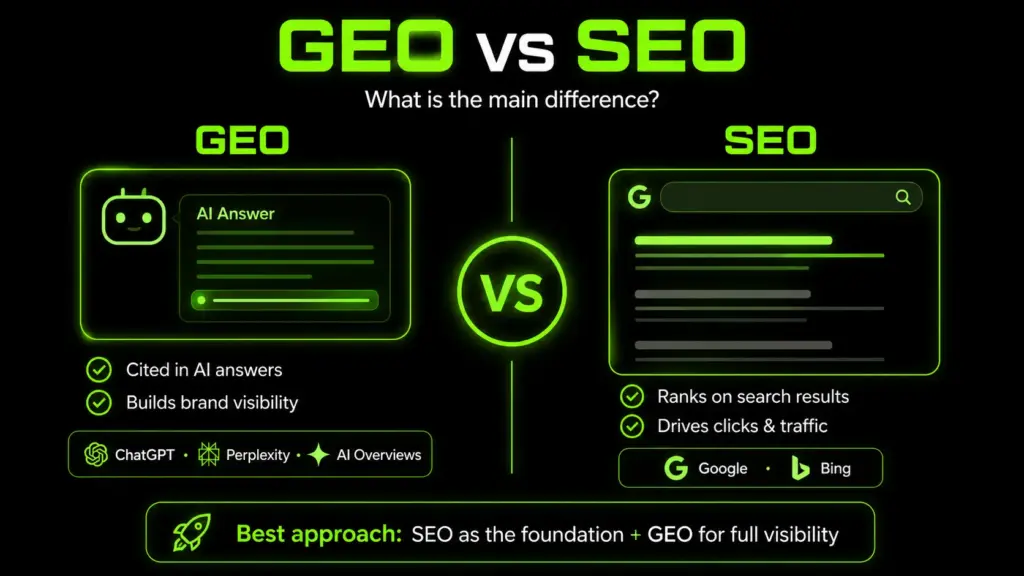
GEO vs SEO comes down to where your content appears: generative engine optimization gets your content cited inside AI-generated answers, while search engine optimization ranks your pages on traditional search engine results pages. For marketers, content strategists, and businesses deciding how to allocate effort in 2026, that difference determines whether you show up as a clickable result, a source inside tools like ChatGPT and Google AI Overviews, or both. With 68% of Google searches ending without a click and AI tools like ChatGPT serving over 900 million weekly users, understanding how GEO and SEO differ is now essential to maintaining visibility and staying competitive.
Both SEO and GEO can work together, but they serve distinct purposes and require different tactics. This comparison breaks down what each one is, which platforms they target, how their content and optimization strategies differ, how success is measured, where they complement each other, and when to use one, the other, or both.
The short answer: SEO aims to rank high in search results and drive organic traffic through blue links. GEO focuses on being cited in AI-generated answers from platforms like ChatGPT, Perplexity, and Google AI Overviews. For most businesses, SEO is still the foundation, but adding GEO is now the better choice for full search visibility.
What Is SEO?
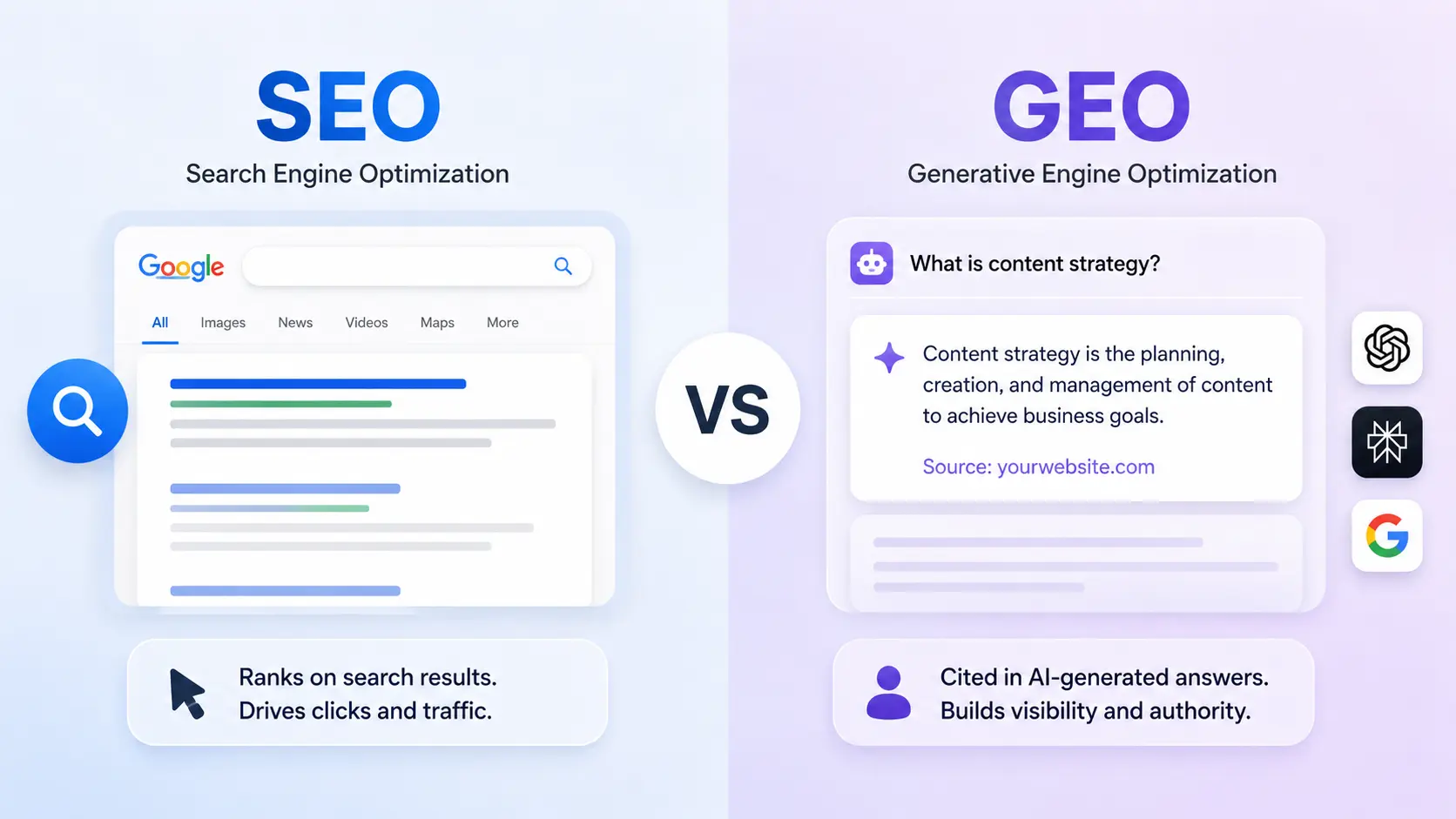
Search engine optimization is the practice of optimizing websites to rank higher in traditional search results on search engines like Google and Bing. SEO aims for maximum reach, targeting anyone searching for specific keywords regardless of location. It focuses on improving organic search visibility using keywords, site structure, quality backlinks, and technical SEO fundamentals.
Core Strengths of Traditional SEO
The main goal of SEO is increasing organic visibility and clicks from traditional search engines. SEO typically takes weeks or months to build rankings and organic traffic, but results compound over time. SEO uses search intent and keywords to match content with user queries, and it remains the backbone of digital discoverability.
What Is Generative Engine Optimization (GEO)?
Generative engine optimization is the practice of optimizing content to be cited in AI-generated answers from AI tools like ChatGPT, Perplexity, Google AI Overviews, and Microsoft Copilot; some marketers also call this answer engine optimization when they mean appearing inside AI-generated responses rather than traditional rankings. Rather than competing for ranking positions among blue links, GEO focuses on making your content the source that AI systems reference when constructing direct answers.
GEO was formally defined in academic research (KDD 2024) and has since evolved into a distinct discipline.
Key Strengths of GEO
GEO requires content to be clear and well-structured. High-quality content increases visibility in AI-generated answers, especially when it includes explicit entity mentions, concise answers, and strong E-E-A-T signals. Content clarity improves chances of being cited by a generative AI tool such as ChatGPT, and structured content helps AI systems extract relevant information.
GEO vs SEO: How They Compare at a Glance
| Factor | SEO | GEO |
|---|---|---|
| Target platforms | Google, Bing, and other search engines (traditional search results) | AI engines: ChatGPT, Perplexity, Google AI Overviews, AI Mode, Copilot |
| Core output | Ranked clickable links on search engine results pages | Being cited or referenced in AI-generated answers |
| Content format | Long-form guides, blog posts optimized for keyword strategy | Structured definitions, FAQs, comparison tables, data-rich explainers |
| Success metrics | Rankings, organic traffic, CTR, conversions | AI citations, brand mentions, Citation Share of Voice |
| Timeline to results | 6–12+ months for stable rankings | 2–6 months for citation visibility with well-structured content |
| Query type | Keyword-based searches | Conversational prompts and natural-language questions |
| User experience | Users click through to websites | Users receive direct answers; may or may not click |
The main takeaway: SEO vs GEO comes down to rankings and clicks in traditional search versus citations in AI-generated answers — both are essential for full digital presence in 2026.
Target Platforms and Search Engines
Where Traditional SEO Operates
SEO focuses on traditional search engines — primarily Google and Bing — where search results appear as ranked lists of clickable links. These platforms serve billions of queries daily and offer rich results like featured snippets, local packs, and knowledge panels. SEO is used to attract organic traffic from search engines like Google and Bing, and the ecosystem includes well-established tools for tracking performance across Google SERPs and other search engines.
Where GEO Targets AI Platforms
GEO targets AI powered search engines and generative AI tools: ChatGPT (with search mode), Perplexity, Google's AI Overviews and AI Mode, Microsoft Copilot, Claude, and emerging AI assistants. Each AI engine surfaces content differently, and many use query fan out to break one prompt into multiple subquestions before generating an answer — data shows substantial variation in citation behavior. For example, one B2B brand was cited 10× more in Perplexity than in Gemini, and some AI models didn't cite the brand at all.
The growing importance of AI search platforms in 2026 is undeniable. Google AI Overviews now serve over 1.5 billion monthly users, and 13.14% of queries triggered AI Overviews as of March 2025 — a number that continues to grow. AI engines surface content from across the entire web, and missing from either traditional or AI search means missing part of your audience.
Winner: Neither — full search visibility requires presence on both traditional and AI search platforms. Focusing on one while ignoring the other leaves gaps in your reach.
Content Strategy and Optimization Approach
SEO Content Optimization
The traditional SEO approach starts with keyword research to identify search volume and user intent, then focuses on creating content targeting those keywords. Technical SEO elements matter: meta tags, site speed, mobile responsiveness, clean site structure, and schema markup for rich snippets. Off-page signals like quality backlinks build domain authority. SEO focuses on improving organic search visibility using keywords, site structure, and established ranking signals.
SEO uses keywords while GEO uses conversational prompts — this is one of the most practical differences between GEO and SEO when it comes to content creation.
GEO Content Optimization
The GEO approach layers additional requirements on top of SEO foundations. Content needs to be formatted for extractability: clear headings improve AI's understanding of content hierarchy, FAQ sections provide concise answers to specific questions, and comparison tables organize information that AI models can easily parse. GEO requires explicit entity mentions for better AI visibility — people, brands, and products need identification via schema markup and consistent naming.
Creating content for GEO means writing with AI crawlers in mind. Structured data helps both search engines and AI systems interpret content. Content must be fresh, fact-checked, and semantically aligned with the kinds of prompts people use when asking AI assistants questions.
The overlap is significant: both SEO and GEO reward content quality, clarity, accurate information, and strong E-E-A-T signals. Clear structure improves visibility for both SEO and GEO.
Winner: GEO for innovation — it demands new formats and thinking. SEO for proven methods — its foundations are battle-tested. The ideal content strategy layers GEO on top of a solid SEO foundation.
Results and User Experience
SEO: Click-Through and Site Engagement
SEO delivers clickable search results that bring users directly to your website. This creates opportunities for conversions, first-party data collection, email signups, and deeper engagement. Users scanning traditional search results may click multiple links, compare sources, and spend time on-site. SEO measures success with clicks, and the path from search to conversion is well-understood.
GEO: Direct Answers and Brand Authority
GEO provides direct answers within AI responses, often as an AI generated summary that satisfies the user's query without requiring a click. With 68% of Google searches ending without a click in 2026, this zero-click behavior is increasingly common. While this may reduce click metrics, it reinforces brand authority — when an AI system cites your content, it positions you as a trusted source.
40.58% of AI citations come from Google's top 10 search results, which means strong SEO performance often feeds GEO results. The user journeys diverge: someone using generative search typically asks natural-language questions and receives synthesized answers, while traditional search users browse result lists and click through.
Winner: Depends on business goals. If you need traffic, conversions, and direct site engagement, SEO provides more measurable outcomes. If brand awareness, thought leadership, and AI visibility matter more, GEO delivers the advantage.
Measurement and Success Metrics
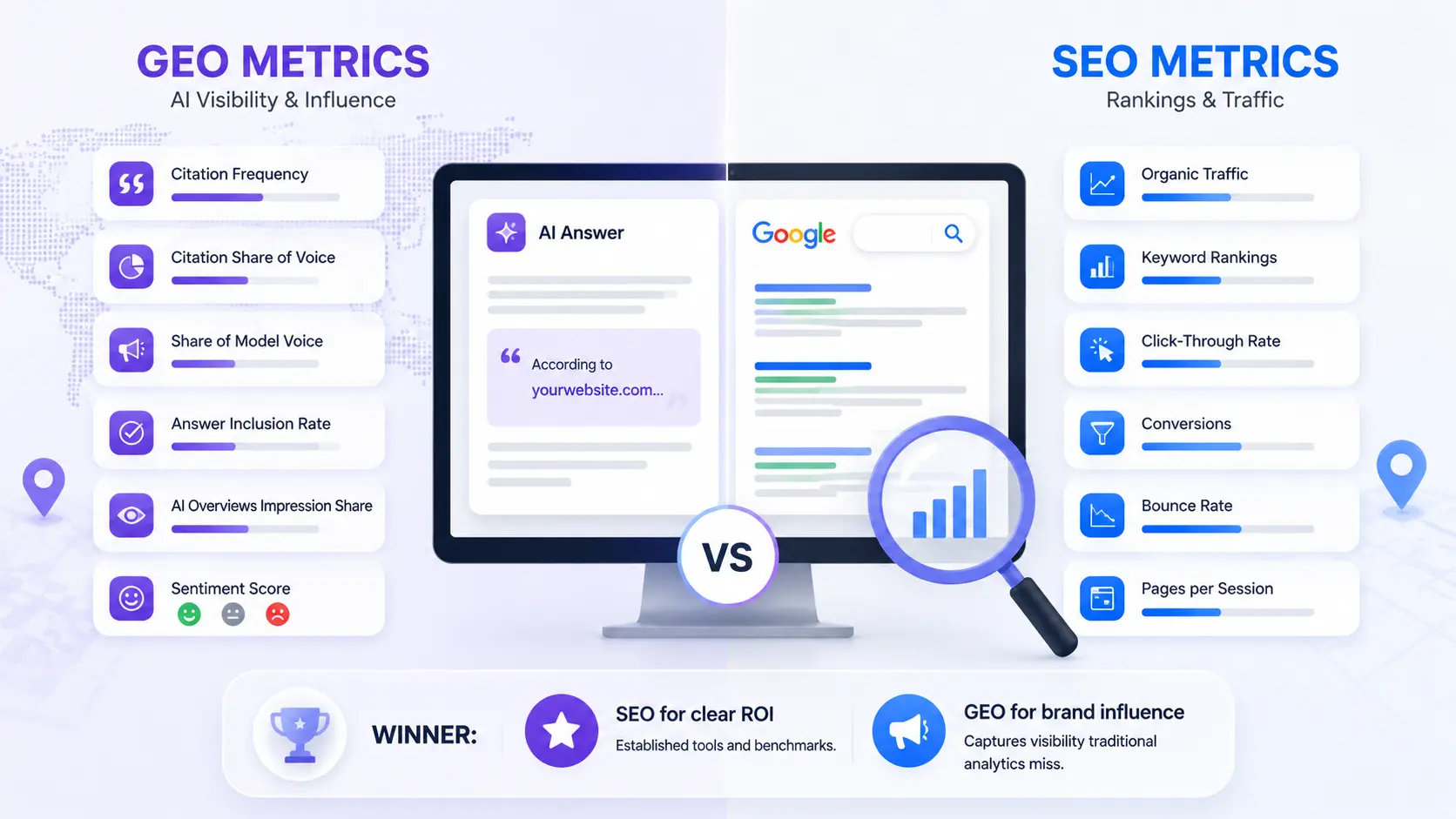
SEO Metrics: Established and Clear
SEO metrics are mature and well-supported by tools:
- Rankings by keyword — track positions across target terms
- Organic traffic volume — measure visitors from search engines
- Click-through rate (CTR) — understand how often impressions convert to clicks
- Bounce rate and time on page — gauge content relevance
- Conversion rate — connect traffic to business outcomes
SEO metrics include clicks, traffic, and bounce rate, all trackable through Google Search Console, Bing Webmaster Tools, and analytics platforms.
GEO Metrics: Emerging and Evolving
GEO metrics focus on citations, mentions, and share of voice in AI responses:
- Citation Frequency / Rate — how often your content is cited in AI answers
- Citation Share of Voice (C-SOV) — your citations relative to competitors
- Share of Model Voice (SOMV) — percentage of AI answers where your brand appears across many prompts
- Answer Inclusion Rate — whether your content is used, regardless of brand mention
- AI Overviews Impression Share — how often your content appears in Google's AI Overviews
- Sentiment Score — whether brand mentions in AI output are positive, neutral, or negative
Real-world benchmarks show what's possible: one UK agency tracked 1,309 total AI citations, an 11% AI citation share, and 43% share of voice during a two-month monitoring period. However, the top 5 domains capture approximately 38% of AI Overview citations, while roughly 26% of brands have zero mentions in AI responses.
Measurement Challenges
The biggest gap in GEO measurement is the lack of a universal analytic dashboard. Unlike Google Search Console for traditional SERPs, AI engines provide limited visibility into how content is used. AI visibility is also probabilistic — small changes in prompt wording, AI model version, or content freshness can shift whether your content gets cited.
Geotargeting success is measured by conversion rates and engagement within specific locations, adding another dimension when both SEO and GEO efforts intersect with local strategies. Geo-targeting can boost click-through rates by 15–25% for ads, and combining SEO with geo-targeting can improve local marketing effectiveness.
Winner: SEO for clear ROI measurement — the tools and benchmarks are established. GEO for brand influence — its metrics capture visibility that traditional analytics miss entirely.
GEO vs SEO: Which Should You Choose?
SEO typically targets a broader audience searching for relevant terms and provides a direct path from discovery to conversion. GEO requires clear, structured content for AI visibility and rewards brands that invest early.
The adoption gap is real: geo matters for businesses that want visibility in AI-driven and location-sensitive discovery, because it helps them appear in recommendations and results shaped by user location, but fewer than 15% have formalized their GEO efforts. That gap represents an opportunity for businesses willing to invest now. Neither approach replaces the other — both SEO and GEO target different surfaces of the same user journey.
How GEO and SEO Work Together
SEO and GEO share fundamental requirements that make them natural partners rather than competitors. Both reward quality content, strong E-E-A-T signals, clean structured data, mobile-friendly design, and solid site speed. The difference is in what each optimizes for on top of that shared foundation.
How to Integrate Them Effectively
Geotargeting delivers location-based ads or content using GPS or IP data, and when combined with SEO and GEO, it creates a three-dimensional visibility strategy — traditional search, AI search, and location-based relevance working in concert.
- Passage-level extractability will matter more than page-level ranking alone for AI citations.
- AI models will increasingly weigh topical authority, evidence strength, and structured response formatting.
- Brands that build on a solid SEO foundation while optimizing for generative engines will capture the most complete digital visibility.
Frequently Asked Questions
GEO complements rather than replaces traditional SEO. Traditional SEO remains critical for discoverability, indexing, traffic, and general SERP presence. GEO adds extra layers for visibility inside AI answer surfaces, but its effectiveness depends on solid SEO foundations like crawlability, domain authority, and structured data. Both serve different but valuable purposes, and the strongest results come from integrating both approaches.
The core difference is what each optimizes for. SEO focuses on ranking among clickable results on search engine results pages. GEO focuses on AI-generated answers and being cited within them. This changes what content you build, what signals matter most, and how success is measured.
Together, SEO and GEO offer full-funnel visibility. SEO ensures content is discovered via traditional search, while GEO ensures content is used in AI answers. They share overlapping best practices — content quality, E-E-A-T signals, technical health, and structured data.
Technically possible, but not recommended. Without SEO, content may not be properly indexed by search engines, and 40.58% of AI citations come from Google's top 10 search results — meaning SEO performance directly feeds GEO outcomes.
ROI depends on your business goals and timeline. SEO often delivers more predictable traffic and conversion ROI over 6–12 months. GEO can deliver earlier gains in brand visibility through AI citations, but monetization is less direct and measurement is noisier.