
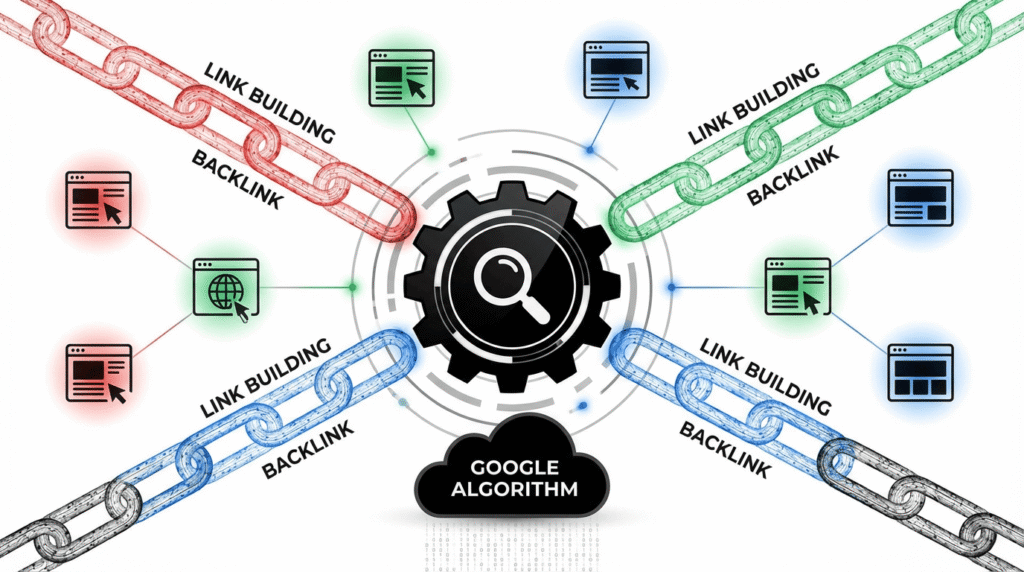
Link Building in 2026: If you’re doing SEO in 2026, you already know one painful truth: link building is still one of the strongest ranking signals, but it’s never been easier to get it wrong. Google’s spam updates in 2025/2026 aggressively target low-value link schemes, scaled outreach abuse, and manipulative backlink tactics.
The good news? Ethical, strategic link building absolutely still works. High-quality backlinks from relevant, trusted sites remain one of the clearest ways to boost authority, rankings, and referral traffic, as long as your approach aligns with modern off-page SEO (search engine optimization) practices and spam policies.
Below are the link-building strategies that are still worth your time after the latest Google updates and how to upgrade them so you’re not just another ignored email in someone’s inbox.
1. Understand What Changed: Google vs. “Old School” Link Building
Google’s recent spam updates focus heavily on:
- Scaled link schemes – mass-produced backlinks, automated guest posts, and networks that exist only to pass PageRank.
- Site reputation abuse – publishing third-party content purely to exploit a site’s authority (think “rented” subfolders and irrelevant guest posts).
- Low-value backlinks – junk directories, comment spam, and links from thin, AI-generated sites.
So the old “spray and pray” off-page SEO approach, buying cheap backlinks, spinning articles, and blasting generic guest posting pitches, isn’t just ineffective; it’s a liability.
Modern link building is about earning or negotiating links that genuinely make sense for users: relevant, contextual, and placed on sites with real audiences.
2. Guest Posting 2.0: Update What’s Outdated, Don’t Add More Noise
Traditional guest posting (“I’ll write a free article if you give me a backlink”) is saturated. Editors get hundreds of those emails every week, and most of them are low-effort templates.
The smarter 2026 version: offer to update outdated content instead of pitching a random new topic.
How to do it
- Find outdated posts on authority sites
Use Google search operators like:- site:example.com “2022”
- “best tools” “2021.”
- Look for content with old dates, missing tools, or screenshots that clearly predate major industry changes.
- Pitch a highly specific upgrade
Your email should sound more like a favor than a request for a backlink. For example:
I noticed your “Best [Topic] Tools in 2022” guide is missing some current options, and a few tools no longer exist. I’d be happy to rewrite or refresh it for 2026, including updated tools, pricing, and screenshots, so it stays one of the best resources in the niche. - Add your link naturally
When you rewrite, include a contextual backlink to your site where it genuinely helps the reader, ideally from a relevant sentence or comparison.
Why this works: you’re solving a real problem (outdated content damages trust and rankings) rather than asking for a favor. Editors are far more likely to say yes when link building clearly benefits their audience.
3. Smarter HARO & Expert Roundups: Flip the Script
Classic HARO-style link building (replying to journalist queries hoping for a backlink) still works, but it’s insanely competitive. For big sites, thousands of SEOs are chasing the same backlinks.
A more scalable 2026 twist: be the one publishing the expert roundup and use it to negotiate backlinks.
The “reverse HARO” method
- Publish on your own site
Create a roundup like “21 Experts Share Their #1 Link Building Tip for 2026” or “Best AI-Powered SEO Tactics According to 15 Marketers.” - Invite experts who want backlinks
Use platforms where experts actively pitch for PR opportunities, or do manual outreach on LinkedIn or email. Offer them a feature and a branded mention. - Ask for a fair backlink in return
Once they’re featured, you can politely request a backlink from their site’s resources page, blog, or about page, framed as mutual exposure, not a link swap.
This type of link building produces editorial backlinks from real businesses and personal brands, often with strong topical relevance, and it aligns with Google’s preference for authentic, expert-driven content.
4. Link Insertions (Niche Edits) Done the Right Way
Link insertions, asking someone to add your backlink into an existing article, have a bad reputation because of spammy outreach (“Please replace your competitor’s link with ours”). But when you pay attention to value and relevance, they still work very well.
How to make link insertions safe and effective
- Target pages that already rank & get traffic
Use your favorite SEO tools (Ahrefs, Semrush, or other SEO tools) to identify pages with strong organic visibility and real backlinks. - Offer a specific upgrade
Instead of “add my link,” say what’s missing: updated data, a unique framework, a case study, or a free tool your content provides. - Mention compensation transparently (if applicable)
In 2026, many sites expect editorial or administrative fees. Don’t hide that. Just make sure the backlink is contextual, relevant, and not part of a huge outbound link farm; that’s where you risk crossing into link scheme territory.
A well-placed niche edit inside a strong, aged article can outperform ten low-quality new posts. The key is restraint and relevance: fewer, better backlinks.
5. Broken Link Building on Fresh Content, Not Just Old Posts
Broken link building is still one of the cleanest white-hat link-building tactics: find dead outbound links and suggest your relevant content as a replacement.
The common mistake? People only look at ancient posts. The site owners don’t care enough to fix them.
Upgrade the tactic for 2026
- Find broken backlinks on popular sites in your niche
In tools like Ahrefs or Semrush, plug in a competitor or authority domain. Filter for pages returning 404 with lots of referring domains. - Sort by “first seen” or recency
Prioritize pages that started linking in the last 1–2 years. Those authors are more likely to remember and care about fixing their broken links. - Pitch with empathy
Your email shouldn’t be “I want a backlink.” Instead:- Show them where the broken link is.
- Explain briefly why a broken link is bad for user experience and off-page SEO.
- Suggest your article as a clean, up-to-date replacement.
Because you’re actively protecting their credibility and user experience, you’re not just asking for a backlink; you’re helping them fix a problem.
6. Unlinked Brand Mentions: Lead With a Favor
Unlinked brand mentions, where a site mentions your brand but doesn’t link, are still a goldmine for link building in 2026.
But rather than emailing, “You mentioned us; please link us,” flip it:
- Find someone else’s unlinked mentions
Identify a brand in your niche you’d like a backlink from. Use SEO tools and content search to pull a list of places where they are mentioned without a link. - Do the legwork for them
Compile those URLs into a simple spreadsheet: page URL, context, and the exact phrase where their brand appears. - Give first, then ask
Send them the list as a helpful gesture:
I’m a fan of your brand and noticed a bunch of sites mention you but don’t link. I pulled together a list so your team can easily reclaim those backlinks if you want.
At the end, politely ask whether they’d consider adding a backlink to your best resource in return.
This is relationship-first link building. You’re proving your value before asking for anything.
7. Tool-Powered Prospecting and Safer Scaling
Manual link building alone won’t scale. To keep your backlink profile strong and natural in 2026, you’ll need a small but powerful stack of link-building and SEO tools.
A good workflow might include:
- An on-page SEO plugin (like Rank Math) to make your pages link-worthy and structurally sound.
- A backlink analysis tool (Ahrefs, Semrush, etc.) to track your existing backlink profile and find prospects.
- Outreach and email tools to manage campaigns without spamming.
For a curated breakdown of what’s worth using right now, check out Rank Math’s guide to the best link-building tools in 2026.
The more systematic your prospecting and outreach, the easier it is to avoid spammy patterns, like sending the same email to 500 irrelevant domains or building 50 identical anchor-text backlinks in a week.
8. Off-Page SEO Mindset for 2026 and Beyond
In 2026, successful off-page SEO isn’t about exploiting loopholes; it’s about earning signals of trust that algorithms can verify:
- Backlinks from real sites with real traffic
- Contextual placement inside content, not random footers or sidebars
- Diversity: guest posts, link inserts, digital PR, broken link building, and brand mentions
- Consistent internal linking on your own site so new backlinks actually flow authority to the right pages
If your link-building strategy looks suspicious in a manual review or embarrassing in a leaked screenshot, it’s not future-proof.
Instead, focus on solving problems for other site owners: updating outdated content, fixing broken links, making their articles more accurate, and amplifying their brand. When you do that, backlinks become a natural, negotiated outcome rather than a forced transaction.
Micro-FAQs: Link Building in 2026
Q1: Is link building still important after all the Google spam updates?
Yes. Google still relies heavily on backlinks as a signal of authority and trust. The updates don’t kill link building; they kill low-quality, manipulative link schemes. High-quality, relevant backlinks are more valuable than ever.
Q2: How many backlinks do I need to rank in 2026?
There’s no fixed number. It depends on your niche, competition, and content quality. A handful of strong backlinks can beat hundreds of weak ones. Focus on earning backlinks from relevant, authoritative sites rather than chasing a raw number.
Q3: Is guest posting safe in 2026?
Guest posting is safe when it’s editorially relevant and genuinely useful for readers. It becomes risky when you publish mass, low-quality posts on unrelated sites just to get backlinks. Aim for quality, not volume, and prioritize context over keyword-stuffed anchor text.