


ChatGPT Ads are clearly labeled sponsored placements shown separately from the assistant's answer, targeted through conversational context rather than keywords. Businesses advertise through Ads Manager with CPM, CPC, or conversion-optimized CPC bidding, starting from a $25-per-day minimum in the US. Treat it as a controlled test — real campaign data still shows cheap clicks can arrive with zero tracked conversions.
ChatGPT Ads are turning conversational AI into a new paid acquisition channel. Instead of interrupting someone scrolling through a feed or competing for a traditional search keyword, advertisers can appear while people are actively researching products, comparing alternatives, solving problems, and deciding what to do next.
That difference makes ChatGPT advertising interesting, but it does not automatically make it profitable. The platform is still developing, campaign controls differ from Google and Meta, and businesses need to understand how conversational relevance, bidding, tracking, and landing-page quality work together.
This guide explains what ChatGPT Ads are, how businesses can advertise, what they cost, and how to test them without treating an emerging platform like a guaranteed growth engine.
What Are ChatGPT Ads and How Do They Work?
Ads in ChatGPT are sponsored placements displayed separately from the assistant's normal answer. They are designed to surface relevant businesses or products when a user's conversation indicates commercial or decision-making intent.
Someone might ask for help choosing software, comparing products, planning a purchase, finding a solution to a problem, or evaluating alternatives. A relevant sponsored placement can then appear below the response.
The key distinction: paid placement does not purchase influence over the answer itself. The advertising layer and ChatGPT's answer remain separate.
How ChatGPT Ads Appear to Users
A typical placement can contain an advertiser name, headline, short description, destination page, brand icon, and creative image.
That gives advertisers less room than a long landing page or video ad. Copy therefore has to communicate usefulness quickly.
Rather than writing something vague like "Transform Your Future Today," a productivity company might use a message centered on the specific outcome the user is researching, such as organizing projects or reducing repetitive work.
Successful ChatGPT sponsored results should feel connected to the conversation instead of looking like an unrelated banner dropped underneath it.
Why ChatGPT Ads Represent Different Intent
Traditional search advertising is based heavily on queries and keywords. Social advertising often relies on audiences, interests, behavioral signals, and creative engagement.
Conversational advertising introduces another dimension: context. People frequently explain what they want, why they want it, their limitations, and the alternatives they are considering within the same conversation. That can provide richer intent signals than a two- or three-word search.
For advertisers, this changes the creative challenge. The goal is not simply to win attention. It is to become useful at an appropriate decision point.
How ChatGPT Advertising Targeting Is Different
The biggest mistake advertisers can make is copying a Google Ads strategy directly into ChatGPT.
Conversational targeting is built around relevance to a user's current intent rather than a conventional list of exact-match search terms.

ChatGPT Ads Use Context Hints
Advertisers can organize ad groups around themes and provide context hints describing situations in which an offer may be useful.
Imagine an online piano course targeting people who want to learn blues improvisation. Instead of focusing only on "blues piano lessons," the campaign could describe related situations such as:
- Learning 12-bar blues
- Struggling to improvise over chord changes
- Wanting blues piano lessons for beginners
- Trying to make piano playing sound less mechanical
- Looking for a structured practice course
This approach gives the delivery system a clearer understanding of the problems the advertiser can solve.
The practical lesson is simple: map customer problems, desired outcomes, and buying situations before building campaigns.
ChatGPT Ads Should Match the User's Problem
Creative should then mirror those intent themes.
If someone is exploring how to learn blues piano, "Play Real Blues in 30 Days" communicates more value than a generic brand slogan.
The same principle applies across industries. An SEO company should distinguish between someone investigating technical SEO, content optimization, local rankings, or website audits rather than serving identical copy to every potential customer.
This is also where strong landing pages matter. Improving your on-page SEO can help ensure visitors arriving from a conversational ad immediately find content that matches the promise that earned their click.
How to Advertise With ChatGPT Ads
Businesses in supported markets can use Ads Manager, while other advertisers may gain access through agency, technology, or advertising partners depending on location.
How to Set Up a ChatGPT Ads Campaign
A practical campaign workflow looks like this:
Advertisers can currently work with reach-oriented CPM campaigns, click-focused CPC campaigns, or conversion-optimized CPC campaigns where available.
If your goal is leads, trials, subscriptions, or purchases, conversion measurement should be established before significant spending begins.
How to Write Better ChatGPT Ads
The ad needs to answer three questions almost immediately: Who is this for? What problem does it solve? Why should someone click?
Avoid filling every ad group with minor rewrites of the same message. Test genuinely different angles: outcome, pain point, use case, speed, convenience, comparison, or specific customer need.
AI can accelerate that process. Modern AI writing tools are particularly useful for generating message variations and organizing intent themes, but human review remains essential. Ads still need accuracy, brand consistency, and a clear reason for the customer to care.
How Much Do ChatGPT Ads Cost?
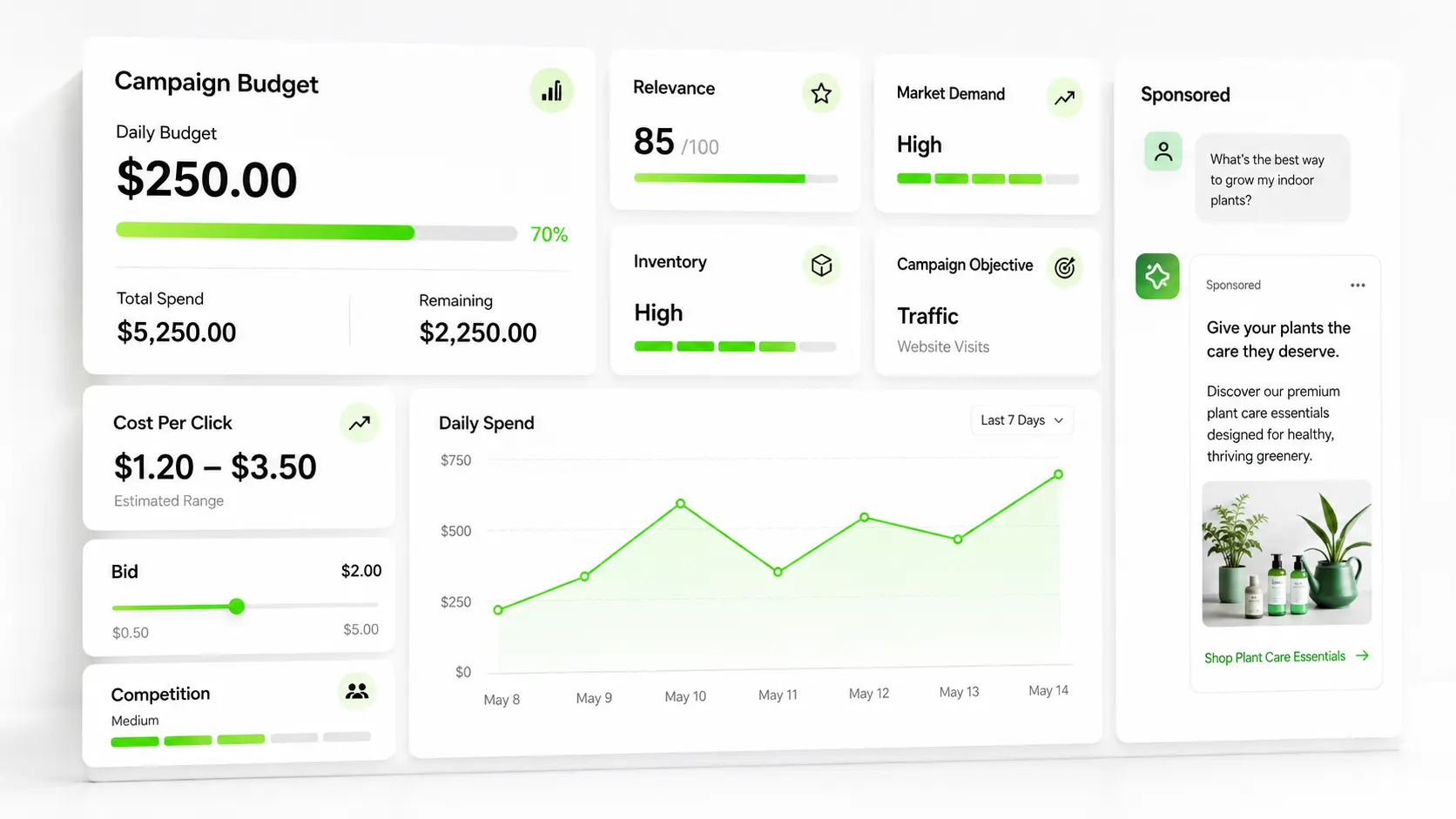
There is no universal price for a ChatGPT ad click. Costs depend on factors such as bidding method, competition, relevance, market, campaign objective, and available inventory.
ChatGPT Ads Pricing and Budgets
| Model | How It Works |
|---|---|
| CPM | Pay based on 1,000 impressions. |
| CPC | Pay for valid clicks. |
| Conversion-optimized CPC | Pay per valid click while delivery is optimized toward a selected conversion event. |
Minimum daily campaign budgets vary by billing market. For example, the U.S. currently has a $25 daily campaign minimum, so older claims that every advertiser can start with no minimum spend should no longer be treated as current guidance.
For manual CPC bidding, a sensible starting point depends on the market and expected customer value. Advertisers should evaluate acquisition economics rather than chasing the cheapest click available.
What a Real Campaign Test Shows
One campaign example from the reference material spent approximately CA$4,459 and generated roughly 170,000 impressions and 1,592 clicks, producing an average CPC near CA$2.80.
At first glance, the traffic metrics looked competitive. The problem was downstream performance: the campaign reported no directly tracked conversions during the test period.
Cheap clicks are not the same as profitable customers.
A 1% click-through rate and attractive CPC can still produce a poor campaign if visitors do not convert.
Do ChatGPT Ads Actually Work?
The most accurate answer is: they can, but businesses should treat the channel as an experiment rather than assuming it will outperform established platforms.
Where ChatGPT Advertising Has Potential
The strongest opportunity comes from reaching people while they are actively thinking through a decision. That may make the platform particularly interesting for:
- Consumer products
- E-commerce
- Software comparisons
- Courses and education
- Travel decisions
- Home improvement products
- High-consideration services
- Research-heavy purchases
Early advertisers also gain something less visible: learning. Brands testing conversational advertising now can discover which problems, offers, and messages resonate before the channel becomes more mature.
Where ChatGPT Ads Still Have Trade-Offs
Google and Meta have had years to develop sophisticated optimization, reporting, audience tools, and campaign workflows. ChatGPT advertising is much newer.
Advertisers therefore need disciplined measurement. Track not only impressions and clicks but also qualified visits, leads, trial starts, purchases, revenue, cost per acquisition, and post-click engagement.
It is also wise to compare paid performance with organic visibility in AI systems. Tools included in a broader AI SEO toolkit can help marketers understand how their brand appears across AI-driven discovery as well as traditional search.
How to Improve ChatGPT Ads Performance
Build for Intent Before Increasing Spend
Start by writing down the questions customers ask before purchasing. Group them by intent rather than by isolated keywords. For example:
Each represents a different moment in the buying journey and may deserve different messaging.
Connect Ads With Strong Organic Content
Paid AI visibility should not exist in isolation.
Create useful pages that explain your products, answer customer questions, demonstrate expertise, clarify pricing or features, and address comparisons honestly.
When your advertising message and organic content reinforce the same customer problem, you create a more coherent journey from conversation to website to conversion.
That is likely to matter more than simply generating hundreds of ad variations.
Final Thoughts on ChatGPT Ads
ChatGPT Ads introduce something genuinely different to paid media: the opportunity to reach users during an active conversation about what they need.
That makes the channel worth watching and, for suitable businesses, worth testing. But it should be approached with realistic expectations. Start with controlled budgets, use specific context-driven messaging, track conversions carefully, and judge results against your existing acquisition channels.
The businesses most likely to benefit from ChatGPT Ads will not simply be those that arrive first. They will be the ones that understand customer intent, build useful content, measure real business outcomes, and adapt as conversational advertising evolves.
FAQs About ChatGPT Advertising
ChatGPT Ads are clearly identified sponsored placements that can appear separately from ChatGPT's normal response. The advertising system considers conversational relevance and other permitted signals to determine when an ad may be useful. Advertisers create campaigns, ad groups, context hints, creatives, budgets, and destination pages while ChatGPT's advertising system determines eligible delivery.
Businesses can create campaigns through ChatGPT Ads Manager in countries where self-service access is available. Depending on the market and advertiser size, access may also be available through approved agency or technology partners. Advertisers select an objective, establish budgets and locations, create intent-focused ad groups and creatives, install conversion measurement, and then monitor results after approval and launch.
ChatGPT advertising does not have one fixed CPC. Pricing depends on the bidding objective, competition, delivery opportunities, relevance, location, and campaign settings. Minimum daily budgets also vary by market; the current U.S. campaign minimum is $25 per day. Businesses should judge costs using conversion rate, customer acquisition cost, lead quality, and revenue rather than CPC alone.
No. Sponsored placements and organic ChatGPT answers are separate. Paying for advertising does not purchase a favorable mention inside the assistant's answer. This distinction means brands should work on both paid acquisition and useful, authoritative web content instead of expecting advertising spend to replace organic visibility.
Small businesses should consider them as a controlled test rather than automatically moving budget away from proven channels. Companies with clear consumer intent, strong landing pages, reliable conversion tracking, and enough data to evaluate results are better positioned to experiment. Start small, compare acquisition costs with existing campaigns, and scale only when the numbers justify additional investment.