

Table of Contents
Introduction
Rank Math SEO is a WordPress SEO plugin that helps website owners optimize pages, blog posts, products, images, schema, sitemaps, redirects, and technical SEO settings from one dashboard. It is useful for beginners who need guided recommendations and for advanced users who want more control over structured data, indexing, local SEO, WooCommerce SEO, and internal links.
This review explains what the Rank Math plugin does, how it works before publishing a post, which features matter most, how to configure important Rank Math SEO settings, and how it compares in the Rank Math vs Yoast discussion.
What Is Rank Math SEO?
How Rank Math SEO Works
Rank Math SEO works by adding SEO controls directly inside your WordPress dashboard. When you create or edit a page, post, product, or custom post type, the plugin gives you options for search appearance, focus keywords, schema markup, indexing rules, and content optimization.
Instead of checking every SEO element manually, you can use Rank Math as a checklist while editing. It reviews important areas such as titles, meta descriptions, keyword usage, headings, internal links, external links, image alt text, schema, and technical settings.
The plugin does not replace strategy, research, or good writing. It helps you organize and check the SEO basics before content goes live.
Why Website Owners Use the Rank Math Plugin
The Rank Math plugin is popular because it combines several SEO features into one tool. Instead of using separate plugins for schema, redirects, XML sitemaps, image SEO, local SEO, analytics, and 404 monitoring, many of these functions can be managed from Rank Math.
This makes it useful for different types of WordPress websites, including blogs, service websites, local businesses, WooCommerce stores, directories, affiliate websites, and content-heavy sites.
When comparing different WordPress SEO plugin options, it helps to review features, ease of use, and long-term maintenance. A broader guide to the best WordPress SEO plugins can help you understand where Rank Math fits among other tools.
How Does the Rank Math Plugin Work?
Rank Math SEO Score Before Publishing
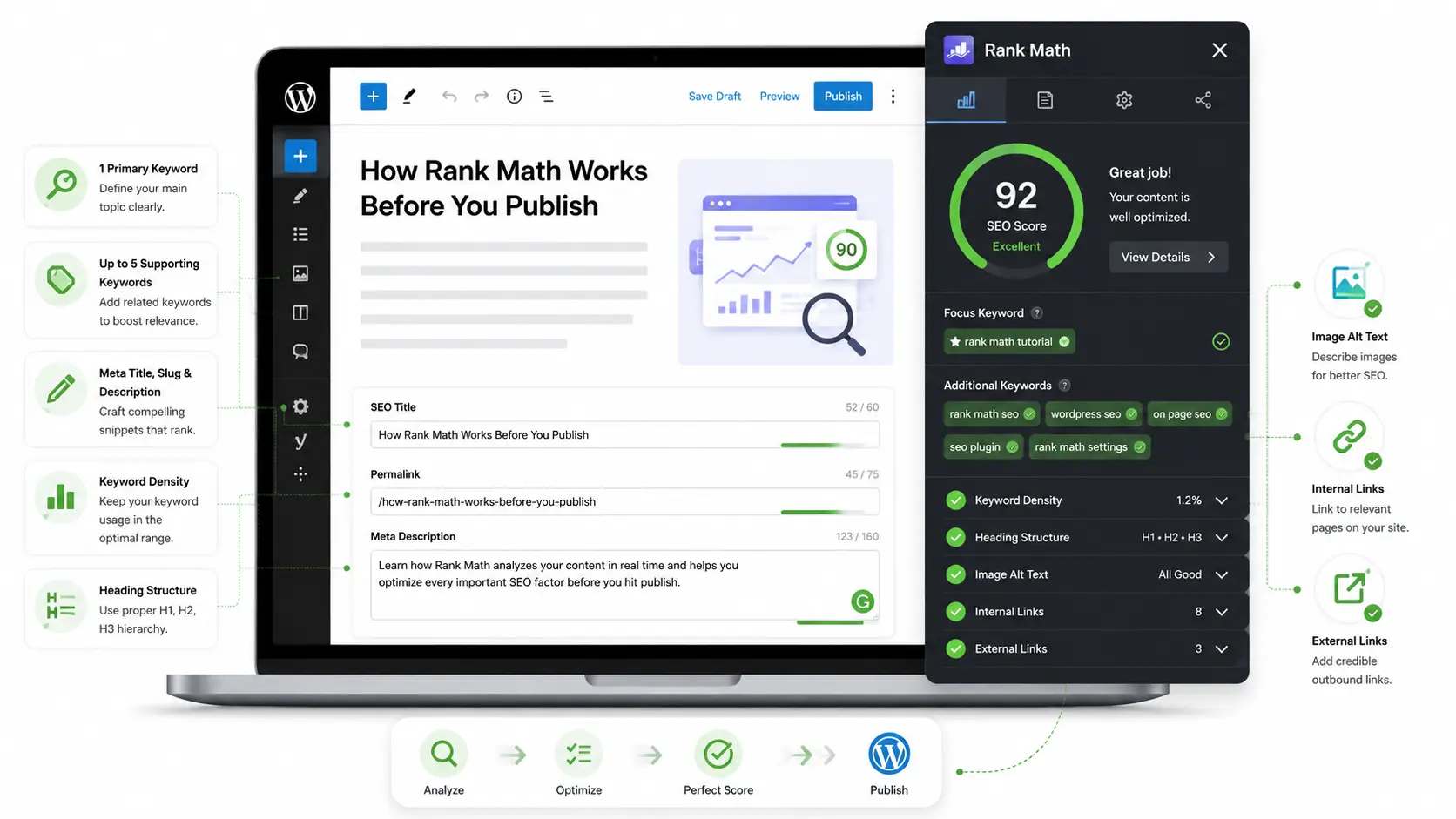
One of the most useful parts of Rank Math is the SEO score shown inside the WordPress editor. When you write a post or page, Rank Math gives the content a score based on how well it follows important SEO checks.
Before publishing, you can enter a primary focus keyword and add secondary keywords when needed. Rank Math allows up to five focus keywords, which helps you optimize for the main topic and related search terms. For example, a review page may use one main keyword and a few supporting keywords that match the search intent.
Inside the same SEO panel, you can edit the meta title, URL slug, and meta description. These fields control how the page may appear in search results and help search engines understand the topic of the content.
It also reviews whether the page uses a clear H1, H2, and H3 hierarchy. This is helpful because a clean heading structure makes the content easier for users and search engines to understand.
The score should not be treated as the only measure of quality. A high score does not guarantee rankings. However, it is useful for catching basic SEO issues before publishing.
Rank Math SEO Options in WordPress Settings
Rank Math also adds SEO options inside the WordPress dashboard settings. These options let you control global SEO rules for your website, including default title formats, meta settings, sitemap behavior, schema types, breadcrumbs, redirects, and indexing preferences.
For example, you can set default title templates for posts, pages, categories, products, or custom post types. You can also control whether certain archive pages should be indexed, whether images should receive automated alt text, and which content types should appear in the sitemap.
This combination of post-level controls and global settings is what makes Rank Math flexible. You can optimize individual pages while also managing site-wide SEO rules from one place.
Key Rank Math SEO Features
Rank Math SEO Modules Included in the Plugin
Rank Math uses a module-based structure. You can activate the features you need and disable the ones you do not use. This helps keep the plugin flexible for small blogs, business websites, large publishers, and online stores.
| Rank Math Feature | What It Helps With |
|---|---|
| Content AI | Provides content suggestions and related keyword ideas. |
| 404 Monitor | Tracks broken URLs and missing pages. |
| Image SEO | Supports automated image alt and title tags. |
| Redirections | Helps manage 301 and 302 redirects. |
| Schema Structured Data | Adds structured data for rich result support. |
| XML Sitemap | Generates sitemaps for important website URLs. |
| WooCommerce SEO | Improves product page metadata and store SEO controls. |
| Local SEO | Adds local business information for location-based search visibility. |
| Analytics | Shows search performance data inside WordPress. |
| LLMS Txt | Helps guide AI models toward important site content. |
Other useful modules include ACF Support, AI Visibility, AMP support, bbPress SEO, BuddyPress SEO, Instant Indexing, Link Counter, News Sitemap, Video Sitemap, Podcast SEO, Role Manager, SEO Analyzer, Google Web Stories SEO, and Link Genius.
Not every site needs every module. A basic blog may only need content analysis, sitemap, schema, and image SEO. A WooCommerce store may need product schema, redirects, local SEO, and analytics.
Most Important Rank Math SEO Features for Beginners
Beginners should focus on the features that improve everyday publishing and prevent common SEO mistakes.
- SEO title and meta description optimization
- Primary and secondary focus keyword checks
- URL slug editing
- XML sitemap generation
- Image alt text support
- Schema markup
- SEO score before publishing
- 404 Monitor
- Redirections
- Internal link counter
- Content AI suggestions
These tools help users write and publish more organized content. Still, strong SEO content needs clear structure, search intent, and useful writing. Many websites combine Rank Math with a proper content writing process to make sure the content is helpful, not just optimized for a score.
How to Set Up Rank Math SEO for WordPress
Rank Math SEO Setup Wizard
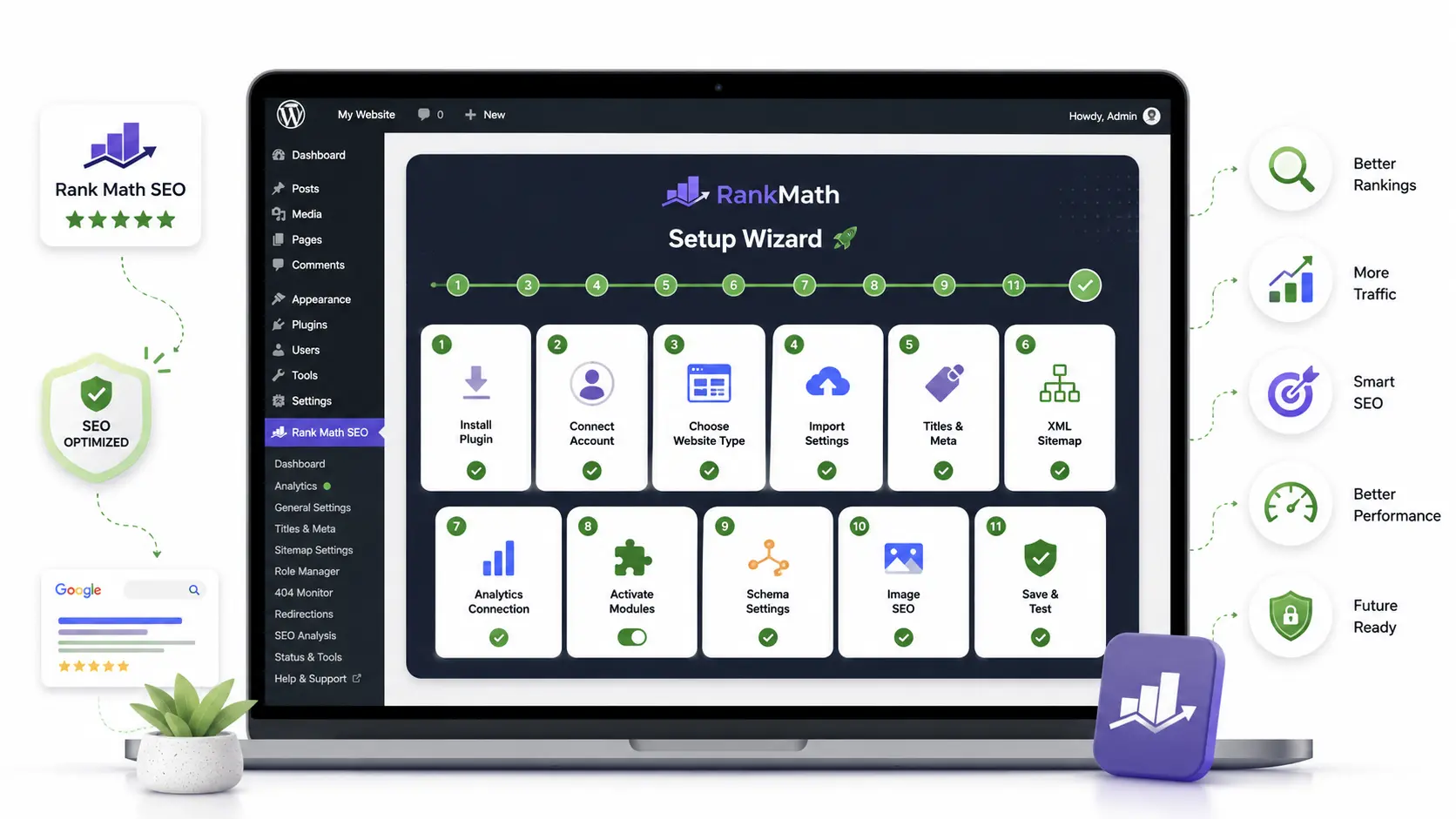
The setup usually starts with the Rank Math setup wizard. This wizard helps configure basic SEO settings without forcing you to manually review every option from the beginning.
| Setup Step | What to Do |
|---|---|
| 1 | Install and activate the Rank Math plugin. |
| 2 | Connect your Rank Math account or skip the connection. |
| 3 | Choose your website type. |
| 4 | Import settings from another SEO plugin if needed. |
| 5 | Configure title and meta settings. |
| 6 | Enable XML sitemaps. |
| 7 | Connect Google Search Console or analytics if required. |
| 8 | Activate important modules. |
| 9 | Review default schema settings. |
| 10 | Check image SEO options, save the setup, and test key pages. |
The setup wizard is useful, but it should not be the final step. After completing the wizard, review the main settings manually, especially if your website already has indexed pages, WooCommerce products, old redirects, or custom post types.
Rank Math SEO Settings for Core Optimization
The most important Rank Math SEO settings control how search engines crawl, understand, and display your pages.
- Titles and meta descriptions
- Robots meta settings
- XML sitemap settings
- Default schema type
- Breadcrumbs
- Image alt text automation
- Redirections
- 404 Monitor
- Local SEO details
- WooCommerce SEO settings
- Role Manager access
Wrong settings can create SEO problems. For example, accidentally noindexing important pages can remove them from search results. Including low-value pages in the sitemap can also waste crawl attention.
Rank Math can guide basic on-page improvements, but a complete on-page SEO process should also review intent, headings, internal links, content depth, page layout, and user experience.
Rank Math SEO Settings You Should Review
Rank Math SEO Settings for XML Sitemaps
XML sitemaps are one of the most important technical SEO features inside Rank Math. A sitemap helps search engines discover posts, pages, categories, products, and other important URLs.
- Enable the Sitemap module.
- Include important post types.
- Exclude thin or low-value pages.
- Review category and tag sitemap settings.
- Check WooCommerce product sitemap settings if needed.
- Submit the sitemap in Google Search Console.
- Make sure blocked or noindexed URLs are not included.
A clean XML sitemap helps search engines understand which URLs should be crawled and indexed, especially on websites with many posts, products, categories, or archives. You can also review this detailed guide to XML sitemap SEO for a stronger sitemap structure.
Rank Math SEO Settings for Schema and Rich Results
Schema is one of Rank Math’s strongest features. Structured data helps search engines understand the type and purpose of your content.
Common Schema Types
- Article schema
- Product schema
- Local business schema
- FAQ schema
Other Useful Schema
- Video schema
- Breadcrumb schema
- Web Stories schema
- Podcast schema
Schema does not guarantee rich results. However, it gives search engines clearer information about the page and can support better search visibility when used correctly.
Rank Math SEO Pros and Cons
| Pros | Cons |
|---|---|
| Many SEO features in one dashboard. | Some advanced features require a paid plan. |
| Easy setup wizard for beginners. | Beginners may need time to understand all settings. |
| Clean module-based structure. | Wrong settings can affect indexation. |
| SEO score before publishing. | Automated image SEO still needs manual review. |
| Primary and secondary keyword checks. | Content AI suggestions should not replace real strategy. |
| Built-in XML sitemap and schema support. | Schema settings require careful configuration. |
| 404 Monitor, Redirections, Local SEO, and WooCommerce SEO. | A high SEO score does not guarantee top rankings. |
Main Benefits of Rank Math SEO
Rank Math offers many advantages for WordPress users who want both content and technical SEO tools in one plugin. Users can review the score, fix missing items, adjust metadata, improve heading structure, and publish with more confidence.
Possible Limitations of Rank Math SEO
Rank Math is powerful, but not every website needs every feature. Beginners may feel overwhelmed if too many modules are activated at once. The best approach is to activate only the modules you need. Start with core settings, then add advanced features when your SEO process becomes more developed.
Rank Math vs Yoast: Which Is Better?
Rank Math vs Yoast for Features
The Rank Math vs Yoast comparison usually comes down to features, interface, pricing, and user preference. Rank Math often feels more feature-rich because it includes modules for redirects, schema, 404 monitoring, local SEO, WooCommerce SEO, analytics, and content optimization in one plugin.
Yoast is also a strong SEO plugin. It is often preferred by users who want a simpler workflow and a familiar interface.
| Comparison Area | Rank Math SEO | Yoast SEO |
|---|---|---|
| Features | More built-in modules and advanced controls. | Simpler feature set with a familiar workflow. |
| Best For | Users who want schema, redirects, analytics, local SEO, and WooCommerce SEO in one dashboard. | Users who want a simple SEO plugin for basic optimization. |
| Interface | Modern, modular, and feature-rich. | Simple, familiar, and beginner-friendly. |
| Control | More technical and site-wide controls. | Good for users who prefer fewer settings. |
Rank Math vs Yoast for WordPress SEO
Rank Math SEO is not automatically better for every website. It is better if you need more features, modular controls, schema flexibility, and technical SEO options. Yoast can still be a good choice for basic SEO needs, especially for users who want a simpler setup.
For a blog, either plugin can work well. For a WooCommerce store, local business site, or content-heavy website, Rank Math may provide more control from one dashboard.
The better choice depends on your website type, SEO goals, budget, and comfort with advanced settings. A plugin should support your SEO workflow, not make it harder.
Who Should Use Rank Math SEO?
Best Website Types for Rank Math SEO
Rank Math can work well for many WordPress websites, including SEO blogs, business websites, local service websites, WooCommerce stores, news websites, affiliate websites, portfolio websites, educational websites, directory websites, and content-heavy websites.
It is especially helpful when a website needs schema, XML sitemaps, redirects, analytics, internal linking support, image SEO, and content optimization in one place.
A local business can use it for local SEO and schema. A store can use it for product metadata and WooCommerce SEO. A publisher can use it for article schema, sitemaps, and content analysis.
When Rank Math SEO May Not Be Enough
Rank Math is an SEO plugin, not a full SEO strategy. It can help optimize technical and on-page elements, but it cannot fully replace keyword research, competitor analysis, content planning, link building, UX improvements, page speed optimization, or technical audits.
For example, Rank Math can show whether a keyword appears in the title, but it cannot guarantee that the page satisfies search intent better than competitors. It can help you add internal links, but it cannot decide your full site architecture.
This is why the best results come from combining Rank Math with high-quality content, clean technical SEO, and a clear publishing strategy.
Final Thoughts
Is Rank Math SEO Worth Using?
Rank Math SEO is one of the most complete WordPress SEO plugins for users who want control over content optimization, sitemaps, schema, redirects, analytics, local SEO, WooCommerce SEO, and technical settings.
Its modular structure makes it flexible, while features like Content AI, Image SEO, 404 Monitor, Redirections, Schema, Sitemap, SEO Analyzer, and the pre-publish SEO score make it useful for both beginners and advanced users.
For most WordPress websites, Rank Math is a strong option. The key is to configure it carefully and avoid enabling features you do not understand or need.
Final Recommendation
Rank Math SEO is worth considering if you want a plugin that supports both basic and advanced optimization tasks. It is especially helpful for websites that need more than simple title and meta description editing.
However, the plugin works best when used as part of a bigger SEO process. High-quality content, clean technical setup, strong internal linking, fast pages, and useful user experience still matter. Rank Math SEO can support those efforts, but it cannot replace them.
FAQs
What is Rank Math SEO?
Rank Math SEO is a WordPress SEO plugin that helps optimize pages, blog posts, products, images, schema, sitemaps, redirects, and technical SEO settings. It gives recommendations for focus keywords, meta titles, meta descriptions, links, and readability. It also includes modules for analytics, 404 monitoring, local SEO, WooCommerce SEO, and structured data.
How do you set up Rank Math SEO for WordPress?
To set up Rank Math SEO, install the plugin, run the setup wizard, choose your website type, configure titles and meta settings, enable XML sitemaps, and connect Google Search Console if needed. After setup, review schema, image SEO, redirections, 404 Monitor, and content optimization settings before publishing important pages.
Is Rank Math SEO better than Yoast SEO?
Rank Math SEO can be better for users who want more built-in features, such as advanced schema, redirects, 404 monitoring, local SEO, WooCommerce SEO, analytics, and modular controls. Yoast may be better for users who prefer a simpler interface. The better choice depends on your website type, SEO needs, and comfort with advanced settings.
Does Rank Math SEO show an SEO score before publishing?
Yes, Rank Math shows an SEO score inside the WordPress editor before publishing or updating a post. After you enter a primary keyword, secondary keywords, meta title, URL slug, and meta description, it checks the content and shows what is missing. It can review keyword density, headings, links, image alt text, and other SEO elements.
Is Rank Math SEO enough for WordPress SEO?
Rank Math SEO is a helpful tool, but it is not enough by itself. It supports titles, meta descriptions, schema, sitemaps, redirects, keyword checks, and content analysis, but strong SEO also requires keyword research, quality content, internal linking, backlinks, technical performance, user experience, and regular SEO audits.