
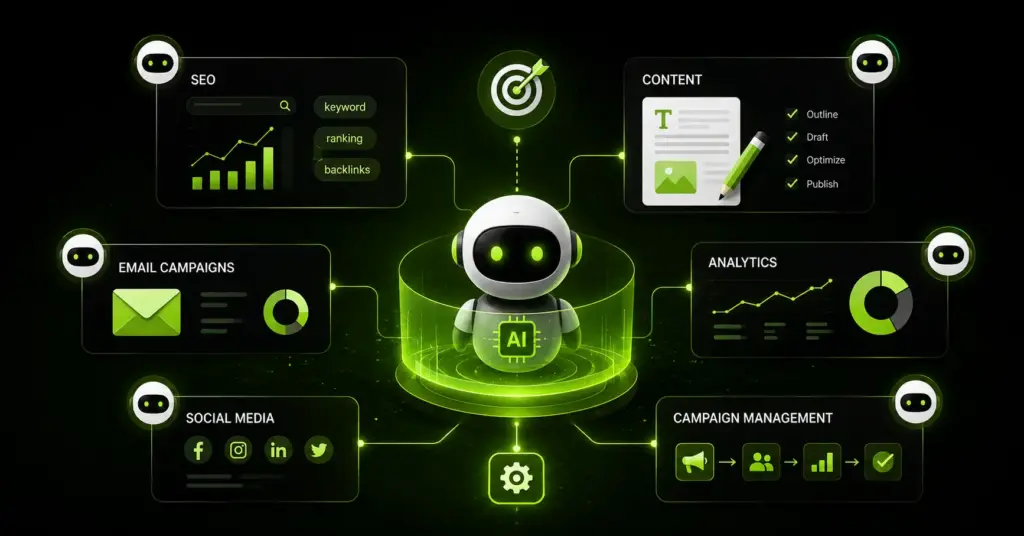
AI agents for marketing are intelligent digital systems that help marketers plan, automate, analyze, and complete marketing tasks with less manual work. They can support SEO, content creation, campaign management, customer communication, analytics, and workflow automation.
Unlike basic automation tools, AI agents can follow goals, process data, make recommendations, and complete multi-step tasks across different marketing channels. For digital teams, marketing AI agents can improve productivity, speed up execution, and make campaigns easier to manage.
What Are AI Agents for Marketing?
AI agents for marketing are software-based systems designed to complete marketing tasks using instructions, data, tools, and workflows. They can help a marketer research keywords, prepare content briefs, organize campaign tasks, review analytics, draft emails, summarize customer behavior, and recommend next steps.
The main idea is simple: instead of asking a tool to complete one isolated action, you can give an AI agent a goal and let it work through multiple steps. For example, a marketer might ask an AI agent to analyze a blog topic, find keyword opportunities, build an outline, suggest internal links, and prepare a draft brief.
That makes AI agents especially useful for busy teams that need speed, consistency, and better organization across several channels.
How AI Agents for Marketing Work
AI agents for marketing usually work with four key inputs:
Tell the agent what to do
Gives it context
Allow it to complete actions
Define the desired outcome
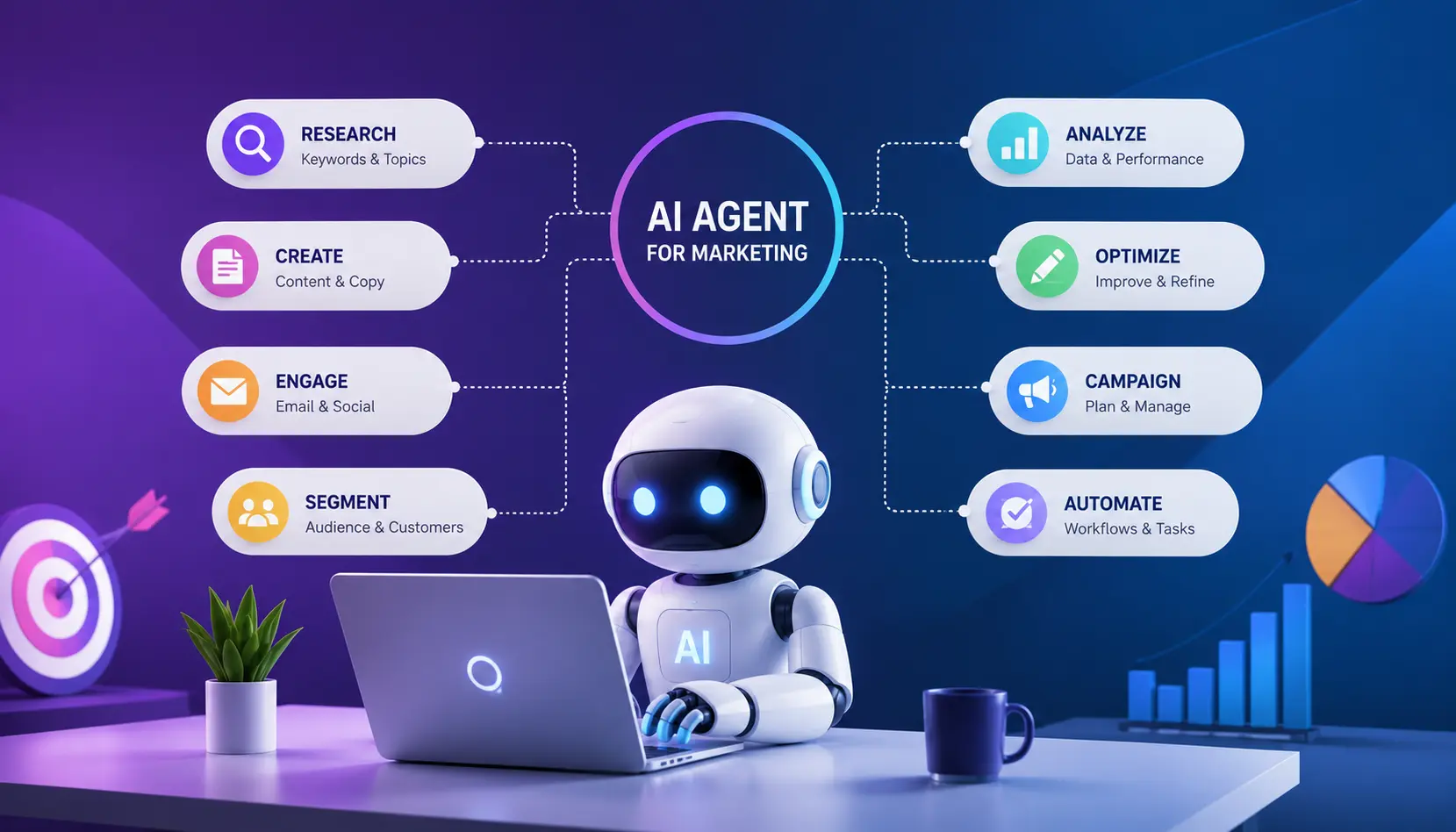
For example, an AI agent can review search terms, group them by intent, compare them with existing website pages, and suggest new article ideas. It can also help with customer segmentation, campaign monitoring, content planning, and reporting. AI agents for marketing can help with:
- Keyword research and topic clustering
- SEO content brief creation
- Blog post optimization
- Email campaign planning
- Paid ad copy suggestions
- Social media content calendars
- Customer segmentation
- Competitor research
- Campaign reporting
- Workflow automation
How Marketing AI Agents Differ From Basic Automation
Basic automation follows fixed rules — for example, "send this email when someone fills out a form." That is useful, but it is limited.
Follows fixed rules. A trigger happens, and a single predefined action runs — no judgment, no context, no flexibility.
Works with context and goals. Can review information, identify patterns, suggest actions, and support more complex, multi-step workflows.
A basic automation tool may send an email. An AI agent can help decide which audience segment should receive it, what message angle to use, and what follow-up sequence might work best.
Why AI Agents in Digital Marketing Are Becoming Important
AI agents in digital marketing are becoming important because marketing teams now manage more tasks, channels, data, and content than ever before. SEO, paid ads, social media, email, analytics, and customer journeys all require regular attention. Without support, teams can spend too much time on repetitive work and not enough time on strategy.
The Role of AI Agents in Digital Marketing Teams
AI agents in digital marketing can act like workflow assistants. They do not replace skilled marketers, but they reduce manual effort. They can help prepare research, organize ideas, summarize data, create first drafts, and monitor performance. This is valuable for small businesses, agencies, freelancers, and in-house teams — instead of switching between tools all day, marketers can use AI agents to connect parts of the workflow and keep projects moving.
Why Marketers Are Moving Toward AI Marketing Automation
AI marketing automation helps teams complete routine work faster while keeping humans focused on creative thinking, strategy, and decision-making. It is especially useful for repeatable tasks such as content briefs, email sequences, reporting, keyword grouping, and campaign summaries.
The best use of AI is not blind automation. It is guided automation. Marketers still need to set the goal, review the output, check accuracy, and make final decisions.

How AI Agents for Marketing Improve SEO
AI agents for marketing can make SEO workflows faster and more organized. They can support research, planning, optimization, and reporting without removing the need for human judgment.
Using AI Agents for Marketing in SEO Research
SEO research often involves many steps: finding keywords, understanding search intent, checking competitors, grouping topics, and planning content. AI agents can help manage these steps in one workflow — grouping keywords by informational, commercial, navigational, or transactional intent, and suggesting topic clusters for blog posts, landing pages, and supporting content.
This helps marketers build a clearer SEO strategy instead of publishing random articles. For a deeper look at SEO workflows, you can also read this guide on how to use AI for SEO.
Content Optimization and Internal Linking Support
AI agents can review a blog draft and suggest better headings, improved meta titles, clearer introductions, missing subtopics, and stronger calls to action. They can also recommend internal links when a website has related content. For example, if a website has pages about SEO tools, content marketing, and lead generation, an AI agent can suggest where those pages should be connected naturally.
How AI Agents Support Content Creation
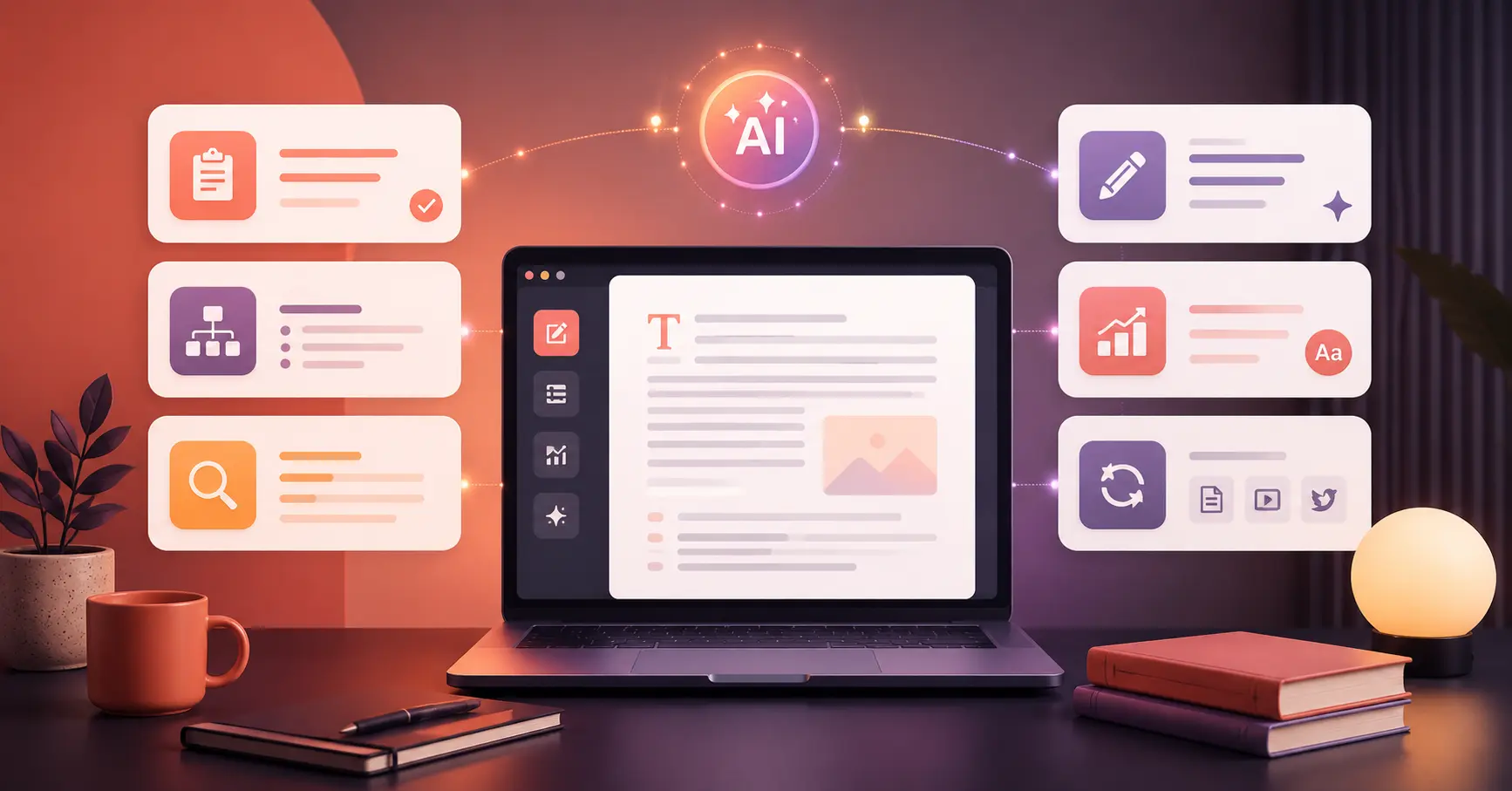
Content creation is one of the most practical areas for marketing AI agents. They can support planning, outlining, drafting, editing, and repurposing content.
Creating Content Briefs and Article Outlines
AI agents can create content briefs that include title ideas, search intent notes, H2 and H3 structures, keyword suggestions, FAQ ideas, meta descriptions, and internal link recommendations. This gives writers a stronger starting point — instead of beginning with a blank page, the writer gets a structured plan that can be improved with original examples, brand insights, and expert commentary.
Improving Content Quality and Readability
AI agents can improve clarity, grammar, tone, structure, and flow. They can simplify long sentences, suggest better transitions, and make content easier to scan. However, human review is still essential — AI can produce generic or inaccurate content if the instructions are weak. The final article should always be checked for accuracy, originality, usefulness, and brand voice.
How AI Agents Help With Campaign Management
Campaign management often includes planning, content creation, audience targeting, tracking, reporting, and optimization. AI agents can help organize these moving parts.
Campaign Planning and Task Automation
AI agents can support email campaigns, paid ads, landing pages, audience segmentation, and campaign calendars. For example, a team launching a new service can use an AI agent to create a campaign checklist, draft email angles, suggest social posts, and prepare landing page sections. This does not remove the need for a campaign manager — it gives the manager a faster way to organize the work.
Reporting, Analytics, and Performance Insights
AI agents can summarize campaign data, highlight trends, identify weak points, and suggest next steps. For example, they can review email open rates, ad performance, landing page conversions, and traffic changes. Instead of reading raw data manually, marketers can get a plain-language summary that helps them act faster.
10 Best Use Cases for AI Agents for Marketing
Benefits of AI Marketing Automation
AI marketing automation helps marketers move faster, reduce repetitive work, and keep campaigns more consistent. It is useful for SEO, content, email, reporting, analytics, and customer workflows.
Faster Marketing Execution
With AI marketing automation, teams can complete research, planning, drafting, and reporting tasks in less time. This allows marketers to publish more consistently, test more ideas, and respond faster to performance changes.
Better Productivity and Consistency
AI agents can help teams follow repeatable processes. For example, every blog brief can include the same SEO checks, every report can follow the same format, and every campaign can include the right planning steps. Still, AI should support human strategy rather than replace it — the strongest results come when marketers combine AI speed with human judgment.

Common Mistakes to Avoid With Marketing AI Agents
Marketing AI agents can be powerful, but they need clear direction. Poor inputs often lead to poor outputs.
For readers who want a broader explanation of how AI agents work, this AI agents guide can be useful.
Final Thoughts on AI Agents for Marketing
Are AI Agents for Marketing Worth Using?
Yes, AI agents for marketing are worth using when they are applied to the right workflows. They can help with SEO, content creation, campaign management, customer segmentation, automation, reporting, and productivity. They are especially useful for repetitive, data-heavy, and multi-step marketing tasks — however, they work best when guided by a clear strategy and reviewed by a human marketer.
How to Start Using AI Agents in Digital Marketing
The best way to start is with one simple workflow. Choose content briefs, SEO optimization, reporting, email marketing, or social media planning. Create a clear process, test the output, improve the instructions, and then expand.
AI agents for marketing are not a magic replacement for strategy. They are practical assistants that help teams move faster, stay organized, and make better use of time.
Need Help Building a Smarter SEO and Content Strategy?
Get professional on-page SEO and content support to combine AI-assisted workflows with expert strategy and human review.
View On-Page SEO Services →FAQs About AI Agents for Marketing
AI agents for marketing are intelligent systems that help marketers complete tasks such as SEO research, content planning, campaign management, customer communication, reporting, and workflow automation. They can follow instructions, process information, and support multi-step marketing activities.
AI agents can support SEO by helping with keyword research, search intent analysis, content briefs, metadata suggestions, internal linking ideas, and content optimization. They can also review existing pages and highlight missing sections or improvement opportunities.
Yes, AI agents can help create blog outlines, email drafts, ad copy, social media posts, product descriptions, and content briefs. Final content should still be checked for accuracy, originality, brand voice, and real value before publishing.
The best use cases include SEO research, content brief creation, email marketing automation, social media planning, paid campaign support, customer segmentation, reporting, workflow management, and competitor research.
AI agents are more flexible than traditional marketing automation tools because they can work with goals, context, and data instead of only following fixed rules. Traditional tools are useful for simple workflows, while AI agents are better for research, content generation, campaign analysis, and recommendations.