
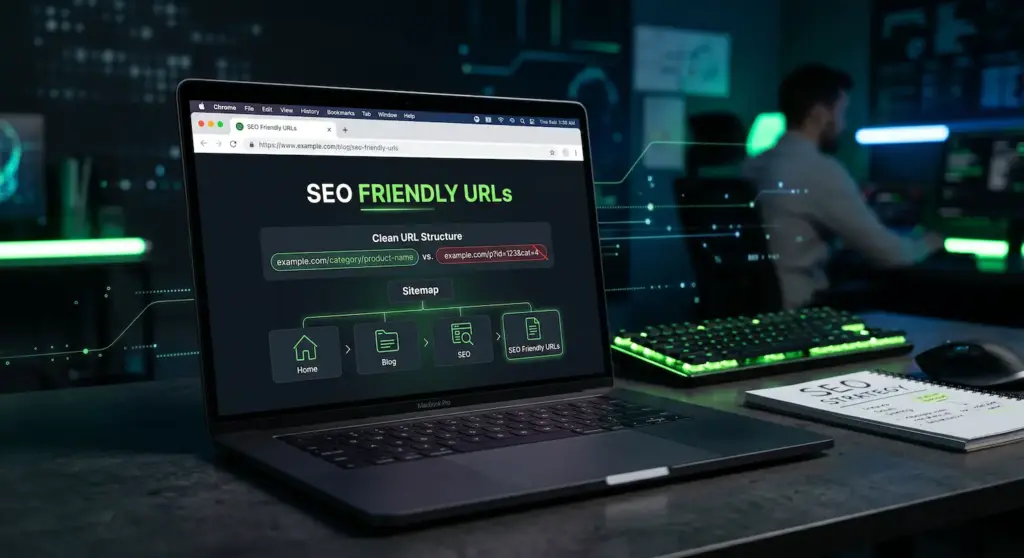
SEO friendly URLs are short, clear, readable web addresses that help users and search engines understand a page before opening it. A clean URL can improve trust, support better crawling, and make your content easier to organize across your website.
For example, /seo-friendly-urls/ is easier to understand than /post?id=8472&cat=seo-guide. The first URL tells visitors exactly what the page covers. The second creates confusion.
In this guide, you will learn what makes a URL search-friendly, how to build a strong SEO URL structure, and how to use URL optimization without overcomplicating your website.
What Are SEO Friendly URLs?
SEO friendly URLs are web addresses written in a simple, descriptive, and user-focused format. They usually include relevant words, avoid unnecessary characters, and match the topic of the page. A good URL should answer one quick question: "What will I find on this page?"
The good version is readable, focused, and easy to remember. The poor version gives almost no useful context.
Why SEO Friendly URLs Matter for Search Engines
Search engines use many page signals to understand content, and URLs are one of the first visible clues. A descriptive URL can support relevance by showing the main topic clearly. This does not mean a URL alone will rank a page — strong content, helpful structure, internal links, page experience, and authority still matter. But clean URLs make the page easier to interpret and support better site organization.
How SEO Friendly URLs Improve User Experience
Users often see URLs in search results, browser bars, social shares, emails, and internal links. A clean URL builds confidence because it looks professional and relevant. A readable URL helps users:
- Understand the page topic quickly
- Decide whether the result matches their intent
- Share the page more easily
- Trust the website more before clicking
What Makes a URL SEO Friendly?
A URL is SEO friendly when it is short, readable, relevant, and aligned with the page's main topic. It should include the main keyword naturally, use hyphens between words, avoid clutter, and reflect the content users will find on the page. A strong URL is written for humans first, then optimized for search visibility.
Clear Keywords and Simple Readability
The best URLs use words people understand. If the page is about URL optimization, the slug should make that clear.
Use your main keyword when it fits naturally, but avoid repeating the same phrase. Keyword stuffing in URLs can look spammy and reduce trust.
Short, Clean, and Descriptive URL Slugs
The slug is the part of the URL after the domain name. In https://ilyasmarketinghub.com/seo-friendly-urls/ the slug is seo-friendly-urls. Good slugs are short, lowercase, and descriptive — they remove unnecessary filler words while keeping the meaning clear.
SEO Friendly URLs: 10 Best Practices to Follow
Creating better URLs does not require a complicated system. The goal is to make every URL clear, consistent, and useful.
1. Use the Main Keyword Naturally in the URL
Your main keyword should appear in the URL when it accurately describes the page. For this article, the best slug is /seo-friendly-urls/ — short, relevant, and directly matching the page topic. Do not force multiple keywords into one URL. A slug like /seo-friendly-urls-seo-url-structure-url-optimization/ looks unnatural and messy.
2. Avoid Dates, Numbers, and Unnecessary Words
Dates can make evergreen content look outdated. Numbers can also create problems if the article changes later.
If you update the article later, the clean version still works without needing to change the URL.
The Full Best Practices List
- Use lowercase letters throughout
- Use hyphens instead of underscores
- Avoid special characters when possible
- Remove duplicate words
- Keep URLs easy to pronounce and remember
- Match the URL with the page title and intent
- Avoid random IDs unless technically necessary
- Use HTTPS across the entire website
- Keep category paths simple and flat
- Redirect changed URLs properly with 301s
How to Build a Strong SEO URL Structure
A strong SEO URL structure organizes pages in a way that makes sense to users and search engines. It shows how pages relate to each other without creating unnecessary depth.
| Page Type | Example URL |
|---|---|
| Service page | /services/seo/ |
| Content service | /services/content-writing/ |
| Blog post | /blog/url-optimization/ |
Keep Your SEO URL Structure Simple and Logical
A simple structure helps users understand where they are on your website. It also helps you manage content as your site grows. For example, a service page for on-page SEO services should use a clean URL that clearly reflects the service.
Use Categories Only When They Add Value
Categories can help organize large websites, but they should not make URLs unnecessarily long. For a small business, simple slugs often work best. For a large blog, categories may help improve navigation — use them when they improve clarity, not when they only add extra words.
URL Optimization Tips for Better SEO Performance
URL optimization is the process of improving URLs so they are easier to read, crawl, share, and maintain. It supports SEO by making each page's purpose clearer.
Match URLs With Page Intent
Every URL should align with the page's purpose. If the page is a service page, use a service-focused slug. If the page is an informational guide, use an educational slug that tells users they are getting an explanation, not a sales page.
| Page Type | Intent | Example Slug |
|---|---|---|
| Service page | Commercial | /content-writing-services/ |
| Blog guide | Informational | /seo-friendly-urls/ |
| Landing page | Transactional | /free-seo-audit/ |
Keep URLs Consistent Across the Website
Consistency makes your website easier to manage. Choose a URL style and apply it everywhere. Always use lowercase, always use hyphens, and avoid mixing formats like /SEO-Friendly-URLs/ or /seo_friendly_urls/ or /seo-friendly-urls.html. A consistent format reduces confusion and looks more professional.
URL Slug SEO: How to Write Better Slugs
URL slug SEO focuses on writing the final part of the URL in a way that is clear, relevant, and search-friendly. The slug should summarize the page in a few words — it should not repeat the full title unless the title is already short.
Why URL Slug SEO Matters
Short and clean URL slugs support better search performance because they improve readability, click confidence, and content organization. They do not guarantee higher rankings by themselves, but they help users and search engines understand page relevance faster. A clean slug also looks better when shared on social media, in emails, and in internal links.
Examples of Good and Bad URL Slugs
| Good Slugs | Bad Slugs |
|---|---|
| /seo-friendly-urls/ | /blog/post12345/ |
| /url-optimization/ | /seo-seo-url-seo-friendly-url-best-url-optimization/ |
| /seo-url-structure/ | /2026/05/21/seo-friendly-urls-guide-updated/ |
| /on-page-seo-services/ | /What_Are_SEO_Friendly_URLS!!!/ |
The best slugs are simple, lowercase, keyword-focused, and easy to understand at a glance.
Common SEO Friendly URL Mistakes to Avoid
Even strong websites often have messy URLs. Most URL problems are easy to prevent with a clear system.
Keyword Stuffing in URLs
Keyword stuffing happens when the same or similar keywords are repeated unnaturally. A URL like /seo-friendly-urls-seo-url-structure-url-optimization-url-slug-seo/ does not improve quality — it makes the URL look forced and less trustworthy. A better option is simply /seo-friendly-urls/. Use one clear focus keyword and let the article content cover related terms naturally.
Changing URLs Without Redirects
Changing old URLs can cause SEO issues if redirects are not handled correctly. If a page already has traffic, backlinks, or rankings, avoid changing the URL unless there is a strong reason. When a change is necessary, use a 301 redirect from the old URL to the new one. Before changing any URL, check:
- Does the page receive organic traffic or backlinks?
- Is it ranking for important keywords?
- Can the issue be fixed without changing the URL?
- Is a redirect plan already in place?
URL changes should be careful, not casual. One broken redirect can silently lose rankings and referral traffic.
Final Thoughts on SEO Friendly URLs
SEO friendly URLs are a small but important part of a strong SEO foundation. They make pages easier to understand, improve site structure, support user trust, and help search engines interpret your content more clearly.
The best approach is simple: write short URLs, use natural keywords, keep slugs clean, avoid unnecessary folders, and maintain consistency across your website. A strong SEO URL structure will not replace helpful content, but it can make that content easier to find, share, and manage. Start with clear URL optimization and build every page around user intent.
Need Help Improving Your On-Page SEO?
Get professional on-page SEO support to clean up your URL structure, metadata, and content optimization.
View On-Page SEO Services →Frequently Asked Questions
A URL is SEO friendly when it is short, clear, readable, and relevant to the page content. It should include the main keyword naturally, avoid unnecessary words, use hyphens between words, and help users understand the topic before clicking. The best URLs are simple enough for both people and search engines to interpret quickly.
An SEO friendly URL should usually be short enough to read and understand at a glance. There is no single perfect length, but shorter slugs are often easier to share, display, and remember. The most important rule is to keep the URL focused on the page topic without adding filler words, dates, or repeated keywords.
Yes, URL structure can support SEO by helping search engines understand page hierarchy, topical relevance, and site organization. A clean SEO URL structure also improves navigation and makes content easier for users to follow. It works best when combined with strong internal linking, helpful content, and a logical website architecture.
Yes, including the main keyword in the URL slug can help clarify the topic of the page. The keyword should be used naturally and only once when possible. Avoid repeating keywords or adding multiple keyword variations because this can make the URL look spammy, difficult to read, and less trustworthy.
Changing old URLs can be risky if the page already has rankings, backlinks, or traffic. A URL should only be changed when there is a clear benefit. When a change is necessary, use a proper 301 redirect from the old URL to the new one so users and search engines can find the updated page without losing link equity.